
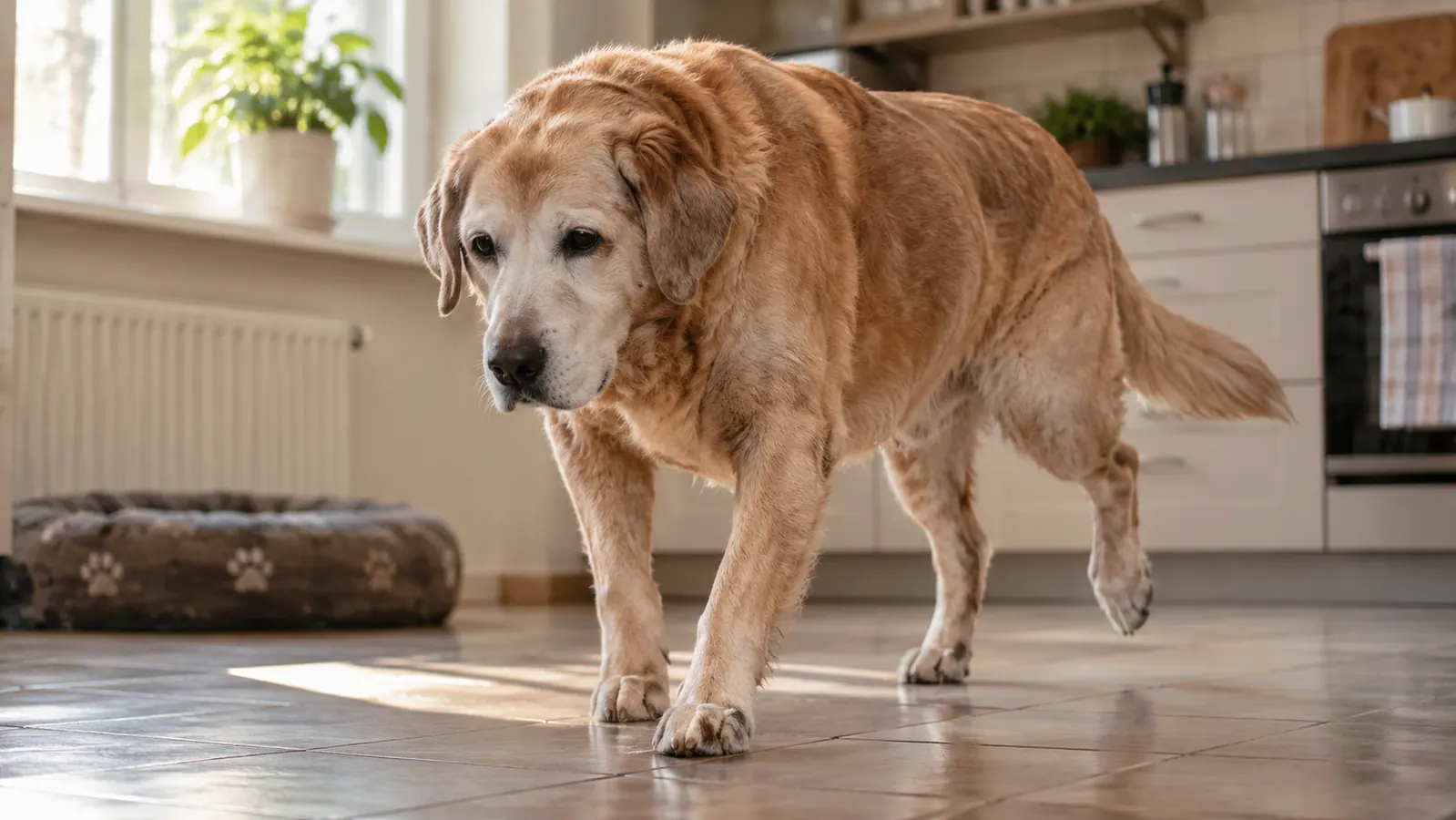
The first time I watched Murphy's back legs slide out from under him on the kitchen tile, I thought he had hurt himself. He had not. He got up, looked faintly embarrassed, and walked on. It happened again two days later, then again the following week, and I finally understood that the tile in my kitchen and hall had quietly become the most dangerous surface in my house. He is a ten year old golden retriever mix, seventy one pounds, and his vet diagnosed arthritis in both hips in January 2026 after he started hesitating at the back steps. The arthritis was not the slipping. The floor was.
Socks were not my first idea. Rubber toe grips were, that January, and two of them popped off in the first week. A bath towel under his belly came after that, and it slid. What finally worked was a set of DOK TigerToes non-slip dog socks in size Large, on his feet from breakfast to bedtime, plus a sling for the two concrete steps at the back door. That is the whole method. What follows is how I got there, in the order I would do it again if I were starting over, including the month I wasted on things that did not work.
The set that stayed on when the toe grips did not
DOK TigerToes come as four socks in a set, size Large for paws measuring 2.5 to 2.8 inches, with a grip built to keep working even when the sock twists. That twist is what killed everything else I tried.
Amazon Check Today's Price on Amazon →Why the Tile Wins and the Dog Loses
A dog walking on carpet gets feedback. The pile gives a little, the toes can spread, the paw pushes back against something. On glazed tile there is nothing to push against. The pad lands, the surface is smooth, and every bit of the dog's forward momentum has to be held by friction alone.
Add a sore hip and the arithmetic gets worse. A sore hip means a shorter stride. A shorter stride means less paw on the floor at any given moment. Less paw means less friction, and less friction means the back end swings out on turns, which is exactly what I was seeing in my hall. He was not being clumsy. He was doing the best he could with the contact he had.
That is why the answer is not to ask the dog to try harder. You change the surface under the paw, or you support the body over it. Socks do the first job. A sling does the second. Neither one touches the joint itself, and I want to be plain about that before you spend a dollar: socks are traction, not treatment. Nothing I put on Murphy's feet did anything for his arthritis, and no product I have bought claims otherwise.
Step 1: Get the vet to look before you buy anything
I taught high school PE and health for thirty one years. I am not a veterinarian and I am not going to write like one. Slipping can be the floor, but it can also be a nail grown into the pad, fur packed between the toes, a paw that is sore for a reason nobody has examined, or a hip that has changed since the last visit. Dr. Sandoval checked Murphy's hips and his paws in the same appointment in January 2026 and confirmed the arthritis I had suspected. She also trimmed the fur between his pads, which I had not known to ask for and which made an immediate difference.
Nails matter more than most people realize. A nail that touches the floor before the pad does lifts the pad off the tile, and a pad that is not touching the tile is not gripping it. I keep his nails short now, and I noticed the change on the hall floor weeks before I bought a single sock.
Once the paws and the joints have actually been looked at, you know what you are solving. In my house it was traction on a flat surface. Everything below is about that one problem.
Step 2: Measure the paw, not the dog
The mistake I nearly made was ordering by body weight. A seventy one pound dog does not automatically take one size, and a sock that is too loose will rotate and slide off, which is the complaint I read most often in reviews before I bought. Put a sheet of paper on the floor, have the dog stand on it with his weight on that paw, mark the widest part of the paw print, and measure between the marks.
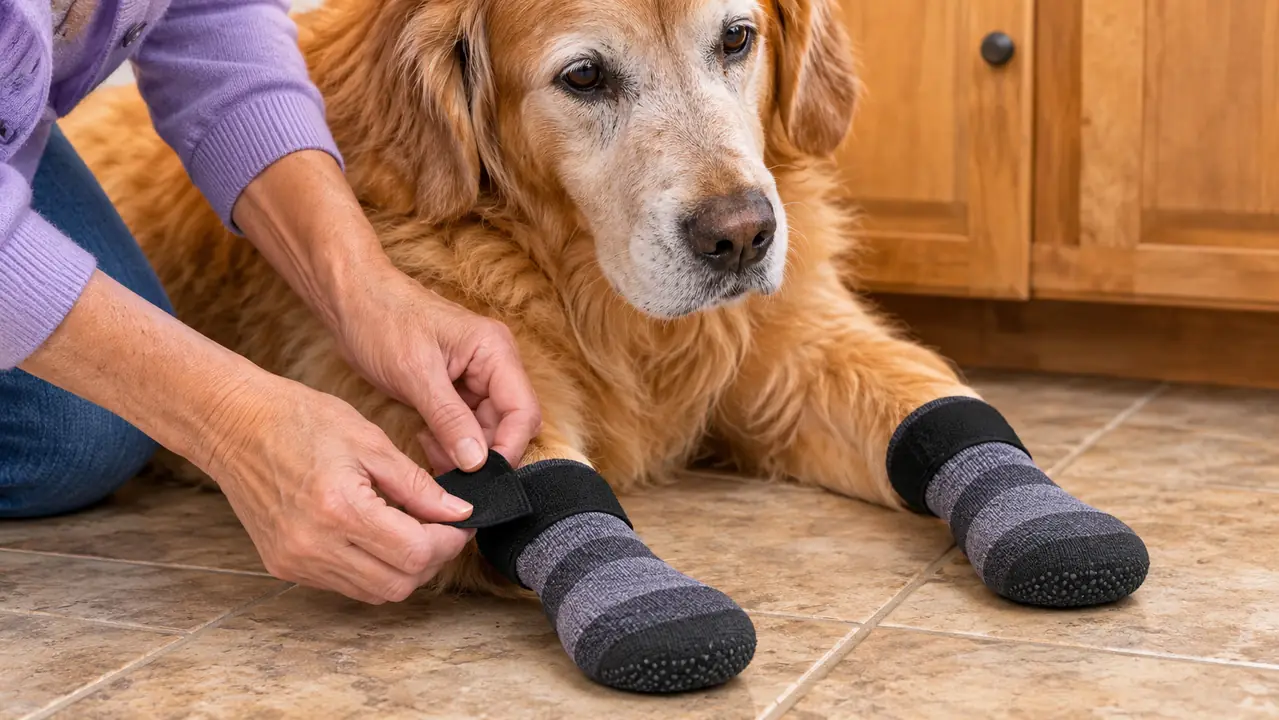
DOK TigerToes in size Large are made for paws measuring 2.5 to 2.8 inches. The set includes four socks, which matters if your dog wears all four the way mine does. The material is cotton and nylon. The closure is hook and loop with a pull-on fit. The care instructions say machine wash, and that was the detail that decided it for me, because I was not going to hand wash dog socks every week for the rest of his life.
If your dog measures between sizes, go up rather than down, and check the fit before you commit to a routine. A sock that stays where you put it is worth more than one that fits beautifully for ten minutes.
Step 3: Put them on for the day, not for the walk
My first instinct was to use socks the way I use shoes: on for outside, off indoors. That is backwards for this problem, because the tile is indoors. Murphy wears his from breakfast to bedtime. They come off at night, they come off for walks, and that is how the slipping stopped, within the first week. Outside he goes barefoot, because grass and concrete give him something to push against and I would rather he felt the ground he was standing on.
The first morning he walked as though the floor were made of ice. High steps, tail low, deeply offended by the whole business. That lasted about twenty minutes. By the afternoon he was crossing the kitchen at his normal speed, which is not fast, but it was his speed again, and I had not seen it in weeks.
One set does the job if you wash it weekly. They live in a basket by the hall, and putting them on is the second thing I do in the morning after starting the coffee. It takes under a minute now. It took closer to five the first week, mostly because Murphy was not helpful.
Step 4: Expect the twist, and expect two days of chewing
Socks rotate. I have washed these every week for nine months and I still find one turned part way around by the end of a day. What surprised me is that it barely matters. The grip on the DOK TigerToes is engineered to hold even when the sock twists in use, so a rotated sock still grips the tile. That single detail is why I am still using this brand and not the ones I tried first, because every other option failed the moment it moved.
He chewed at them the first two days. He is not a chewer and I was still surprised by it. I did not turn it into a fight. I put them on, walked him to his bed, gave him something else to work on, and by the third day he had stopped noticing them entirely. If your dog is a serious chewer, treat these like any fabric on him: watch while they are on, and take them off when you cannot watch.
Step 5: Cover the two places socks cannot help
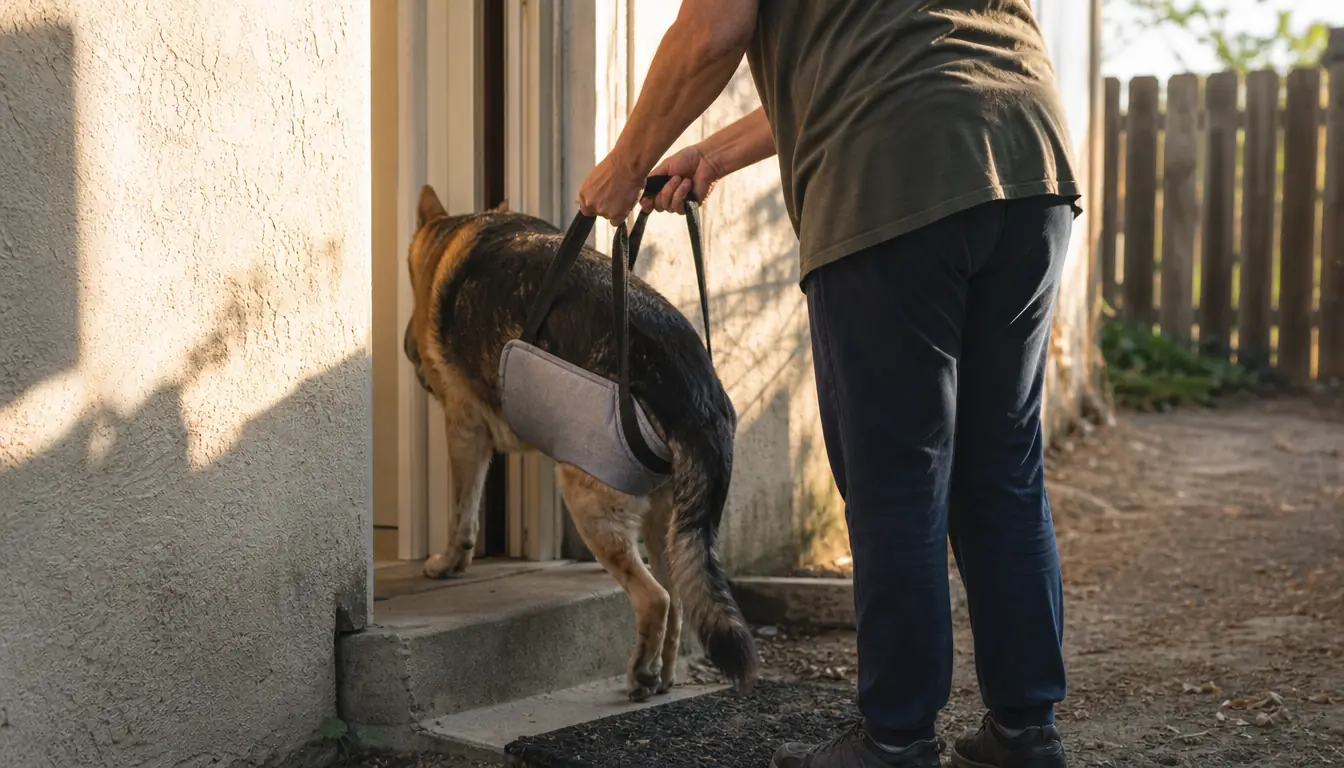
Socks fix flat tile. They do not fix the two concrete steps down to the yard, and they do not fix getting into the back of a car. For those I use a soft hip sling, the LOOBANI lift harness in size X-Large, which is a padded fleece lined panel that sits under his hips with handles I hold. It supports the rear only. It is not a full body harness and it never goes across his chest.
Before the sling I used a bath towel under his belly. It slid, it bunched, and I once nearly dropped him on the step, which is the closest I have come to a genuinely bad morning in all of this. The sling hangs on a hook by the back door and travels in its storage bag to the RAV4 on vet days. Honestly, he is seventy one pounds and I am sixty eight years old, so that sling is as much for my back as for his hips.
Two steps and one car door. That is the entire list. If your dog is fine on the steps and struggles only on the flat, skip this step and buy nothing else.
What Else Helps
Runners. I put two inexpensive carpet runners down the hall in February and they did more for his confidence than anything else in this house, because he could cross a long stretch of tile without a single slide. Socks handle the kitchen, where a runner would be a trip hazard for me. Runners handle the hall. Use both if your layout allows it.
Weight and walking. Murphy eats the same food, measured, and his morning walk at the park is about twenty minutes now instead of the forty it used to be. Short and frequent beats long and rare when a dog is sore. He also gets three things with breakfast or after the walk: a Cosequin soft chew every morning, an unflavored fish oil soft gel tucked into his breakfast, and a mussel chew around noon. Dr. Sandoval okayed all three together before I added each one, and the dose is whatever the label says for his weight, never a number I made up. I cannot tell you which of the three did anything, because I started them inside five months of each other and any answer I gave you would be a guess.
What I can tell you is that none of them fixed the tile. A supplement works on the inside of a joint. A sock works on the floor under the paw. Confusing those two jobs is how a person spends eight months buying the wrong thing, which is more or less what I did before February.
Slipping was not the arthritis. It was the floor. Once I stopped treating the tile as background, the problem got small enough to solve.
What I Would Not Buy Again
The rubber toe grips from January. Two popped off in the first week and one was never seen again. In fairness, they may work well for a dog who stands still and walks slowly on a level surface. Mine does neither.
The pump bottle of salmon oil I tried before the soft gels. It was messy, it smelled up my kitchen, and by the end of the first week I dreaded the morning routine. The soft gels go into his breakfast and I do not think about them again until I open the cabinet.
Start with the floor under his feet, not the joint in his hip
Four socks, size Large for paws measuring 2.5 to 2.8 inches, machine washable, with a grip that survives the twist. It was the simplest thing on my list and the only one where I saw a change inside a week.
Amazon See the DOK TigerToes set on Amazon →