
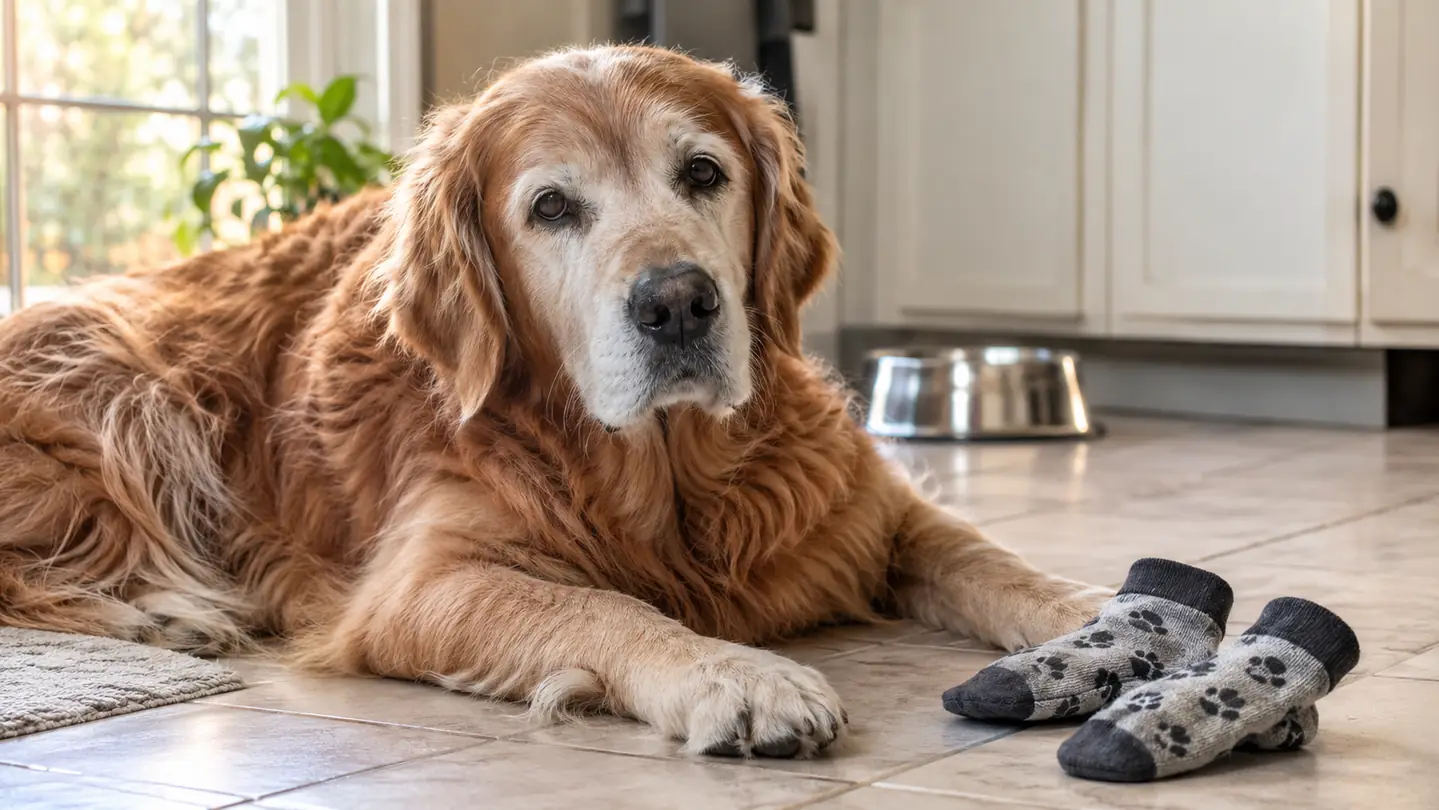
Murphy is a 10-year-old golden retriever mix, 71 pounds, and in January my vet diagnosed arthritis in both hips. The diagnosis explained why he had started hesitating at the two concrete steps off the back door. It did not explain why he kept losing his footing on the kitchen tile, a floor he had crossed without thinking for nine years. Tile gives a paw nothing to push against. That was the whole problem, and it is why I bought a set of DOK non-slip socks in February.
I am not a veterinarian. I taught high school PE and health for 31 years, so what I know is how a body moves and what happens when the surface under it stops cooperating. That is the lens I used here. Below are ten reasons the socks helped my dog, in the order I noticed them, with the parts that did not go smoothly left in.
The four socks that ended the sliding on my kitchen tile
Size Large is listed for paws measuring 2.5 to 2.8 inches across. Murphy wears his from breakfast until bedtime, off for walks and overnight.
Amazon Check Today's Price on Amazon →Ten Reasons They Helped, in the Order I Noticed Them
The sliding stopped inside the first week
This was the only change I could see with my own eyes, so it goes first. Before the socks, Murphy's back feet skated when he turned on the kitchen tile, and he had started taking the long way around through the carpeted bedroom to reach his water bowl. On the fourth day in socks he crossed the kitchen without breaking stride. I cannot prove the socks did that alone. What I can tell you is that sliding was the visible problem, and the sliding stopped.
Tile and hardwood give a paw nothing to push against
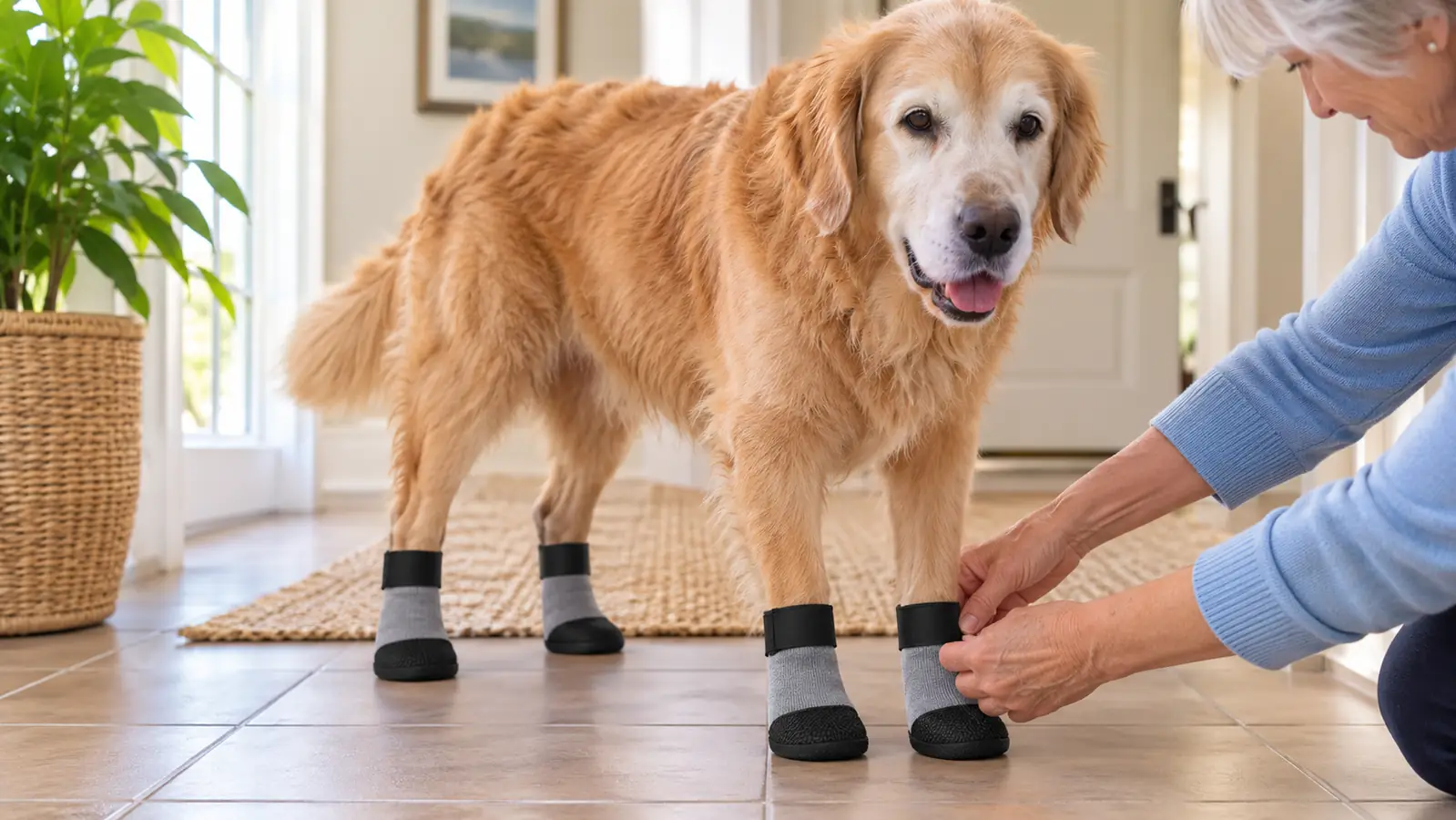
A dog moves by pushing back against the floor. On carpet or grass the pads dig in and the leg does its work. On tile there is no give at all, so a hip that is already sore has to work harder to do the same job, and a foot that lands slightly wrong keeps going. The sock puts a gripping surface between the pad and the floor. It does not make the hip better. It stops the floor from asking more of the hip than the hip has.
Four socks means one for every paw, every time
The set arrives as four socks, which sounds obvious until you have owned a dog product that ships in twos. Murphy wears all four. Saturday morning I take them off, put them through the machine, and set them on the counter by the back door. He sleeps on the bedroom carpet while they dry and they are ready by early afternoon. I have not once had to choose which paw gets protection that day.
The grip still works when the sock has rotated
Nobody warns you that socks rotate. By the end of an afternoon the grip on one of Murphy's back feet can be pointing off to the side instead of down. The listing says the grip is engineered to hold even when the sock twists, and after nine months I believe it, because I have watched the DOK socks carry him across the tile in a turned position and never seen him slide. That detail matters more than it sounds. A sock that only works in perfect position is a sock you are forever bending down to fix.
He gets up on the first try instead of the third
This is the one that made the difference for me. When a dog with sore hips pushes up from lying down, the back feet either catch or they do not. On carpet they catch. On the kitchen tile in December, his right hind foot slid outward and he sat back down and tried again. Now the foot catches. He still takes a second to gather himself before he rises, and I do not rush him. He just no longer loses the attempt.
There is a barrier between a bored dog and his own paw
The listing includes paw licking among the things the socks discourage, and I see the logic. A dog who is lying down more than he used to has more time on his hands and one paw within easy reach. A sock over the paw makes the licking a chore instead of a habit. One caution from me: if your dog is at a paw constantly, that is a vet question and not a sock question. It can be an allergy, a split nail, or something stuck between the pads.
Getting them on takes about a minute once you have a routine
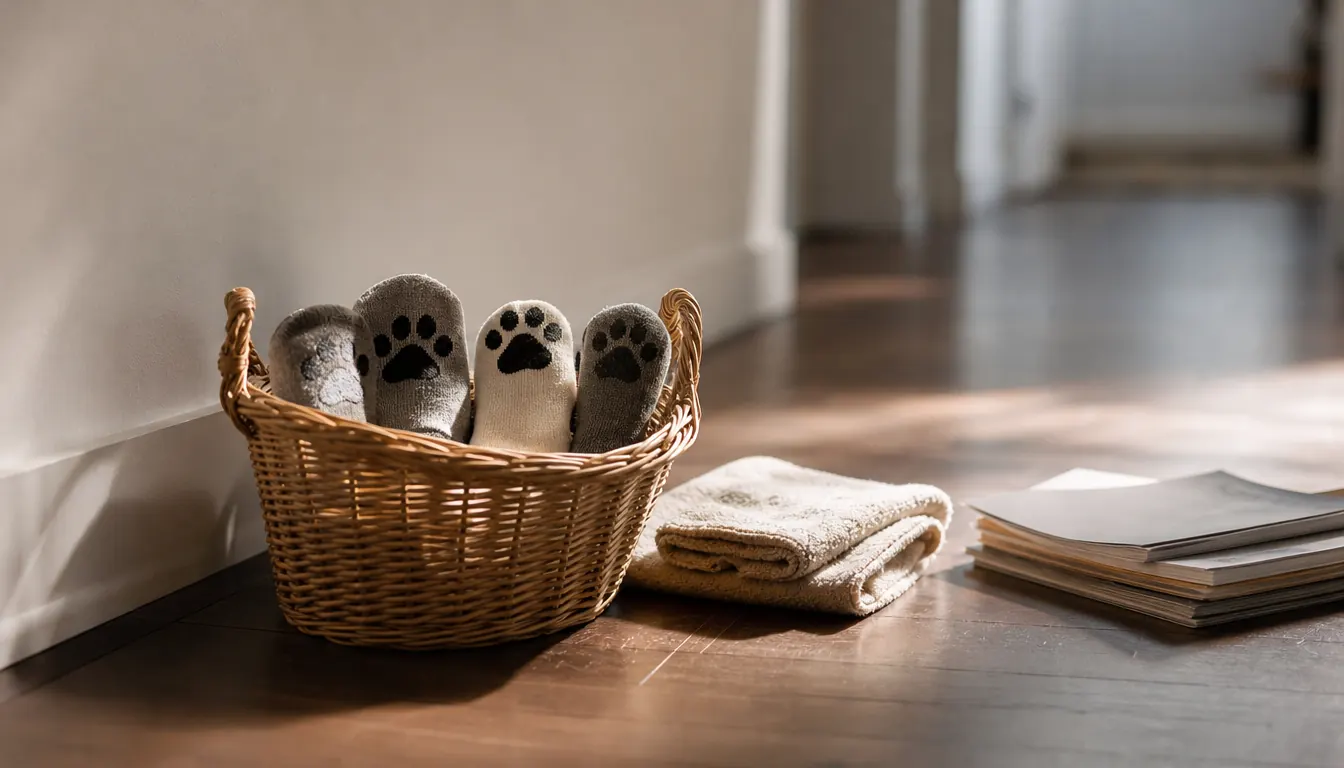
They pull on, and a hook and loop strap at the cuff holds them where you put them. The first two days Murphy chewed at them, mostly out of suspicion, and I let him work through it. By day three he ignored them completely. Now he lies down when he sees me reach for the basket by the hall. I do all four paws in about a minute, faster if he is already flat on his side.
They come through the washing machine week after week
Cotton and nylon, machine wash, and that combination has held up. Nine months of Saturday washes puts this set somewhere near forty trips through the machine, and the cuffs have not gone slack and the grip has not peeled. The strap is the part I expected to fail first and it has not. I air dry them rather than run them through the dryer, which is my habit with anything that has a grip surface on it.
They do one job and they do not pretend to do the other
I want to be plain about this, because it is where a lot of dog gear loses my trust. Arthritis lives in the hip joint. A sock cannot touch the hip joint. What the socks do is traction, and traction is what lets Murphy cross his own kitchen without his feet going out from under him. His hips are Dr. Sandoval's department, and the chews I hand him every morning are a separate conversation entirely.
They gave me back the ordinary mornings
For a few weeks in January I made my coffee standing where I could watch him, waiting for the slide. That is a tiring way to live. The DOK socks did not cure anything and I will not pretend they did. What they did was take one hazard out of a house he has to walk through forty times a day, and now he stands underfoot in the kitchen while I cook, the way he always did. That is worth something to me.
What I'd Skip
Rubber toe grips were the first thing I tried, in January, before the socks. Two of them came off in the first week. I found one in the hallway and never found the other. I also tried a pump bottle of salmon oil in February and quit it: messy on the counter, and it left a smell in the kitchen that stayed for days. And I would skip buying socks as a substitute for a vet visit. If your dog has started hesitating at the stairs, that hesitation is the appointment.
I have never used Dasuquin, so anything I told you about it would be a guess built from labels and from questions I put to Dr. Sandoval. I have also never owned a full body harness. What I own is the DOK socks for the tile, a sling for the two back steps and the RAV4, and three supplements Dr. Sandoval approved before I added each one. Measure the paw before you order, and keep the socks off for walks and for bedtime.
The sliding was the one thing I could see for myself, and the sliding stopped inside a week. Everything else about his hips belongs to Dr. Sandoval.
One hazard out of forty trips through the kitchen
Size Large is listed for paws measuring 2.5 to 2.8 inches across. Measure first. These are traction, not treatment, and the hips still need your vet.
Amazon Check Today's Price on Amazon →