
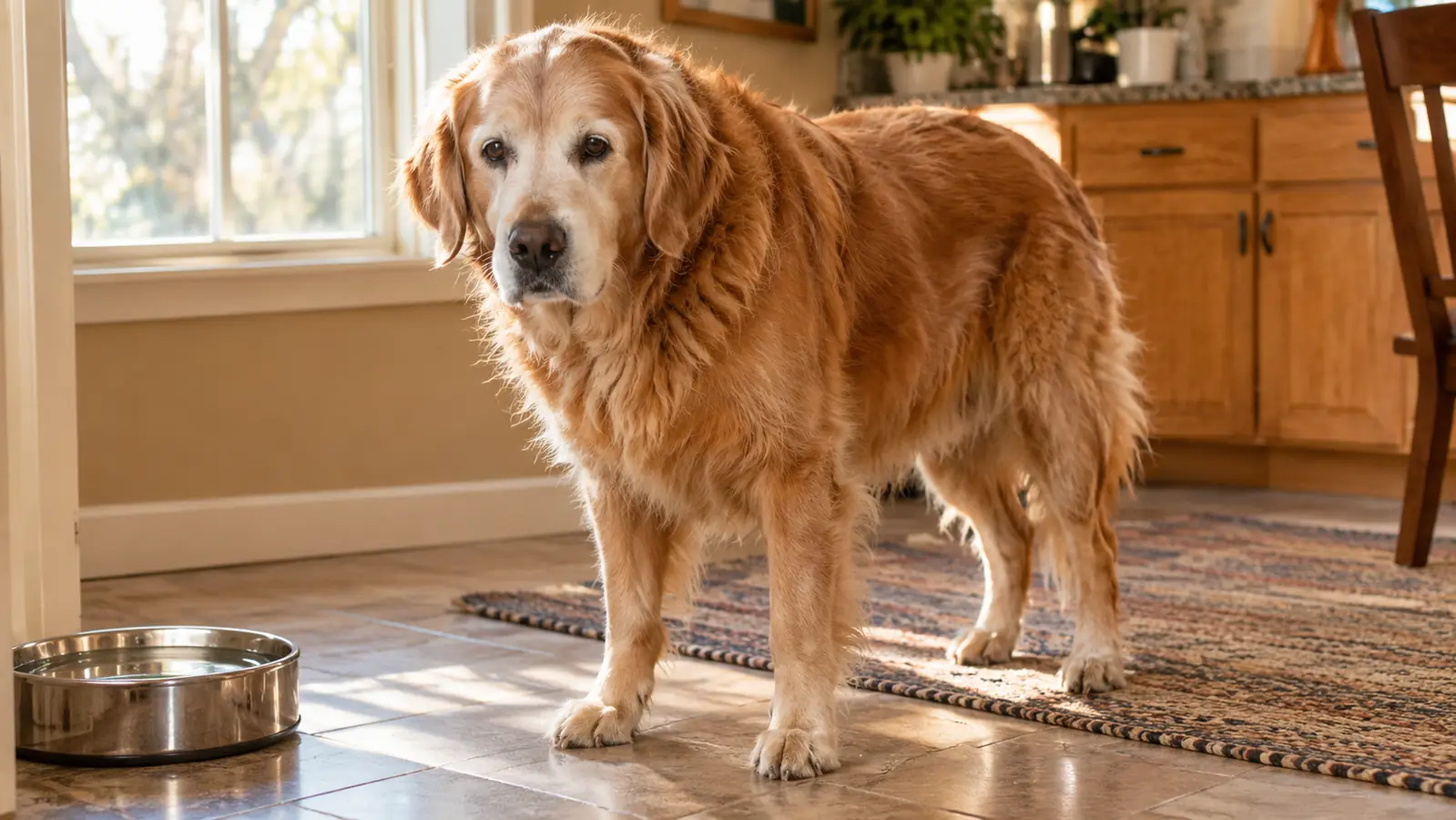
The first thing that changed was the kitchen. Murphy, my ten year old golden retriever mix, stopped following me to the coffee maker. He would stand in the hall doorway, look at the tile, and think it over. Seventy one pounds of dog on four paws that had crossed that floor without a second thought for nine years, and now he was picking his route like a man crossing a creek on stepping stones.
His vet diagnosed arthritis in both hips in January. That explained the hesitation at the two concrete steps out back, and a good deal of the rest of it. What it did not explain was why a floor he had known his whole life had turned into a decision he had to make each morning. It had not, of course. His hips had. But the floor was the one thing in the house I could actually do something about on a Tuesday afternoon, and that is how a set of DOK TigerToes dog socks ended up in a basket by the hall in February.
The Quick Verdict
Reliable traction on tile and hardwood, and the grip survives the twisting that ruins most dog socks. Not a joint treatment, not for walks, and expect to wash them weekly.
Amazon Check Today's Price →The floor stopped being a decision somewhere around day four
DOK TigerToes in size Large, four socks to a set. Hook and loop cuff over a pull-on sock, cotton and nylon, machine washable. Nine months of daily wear in a house with tile in the kitchen and hall.
Amazon Check Today's Price on Amazon →How I've Used It
Size Large. The listing says Large fits paws measuring 2.5 to 2.8 inches across, so I put Murphy's front paw on the kitchen counter with a ruler beside it and got 2.6. That is comfortably inside the range, but I want to be plain about the method, because it is the step people skip. I traced his paw on the back of an envelope first, then measured the tracing across the widest part. Four socks come in a set, which matters more than it sounds, because a dog loses one sock to the yard sooner or later and a set of four means you are down to three rather than shopping again.
They go on after breakfast and come off at bedtime. That works out to somewhere between twelve and fourteen hours a day, which is longer than I expected any fabric to survive on a dog's foot. They come off for walks and they come off at night. A dog in socks on a Redlands sidewalk would be a dog in shredded socks inside a block, and I never felt the need to test that.
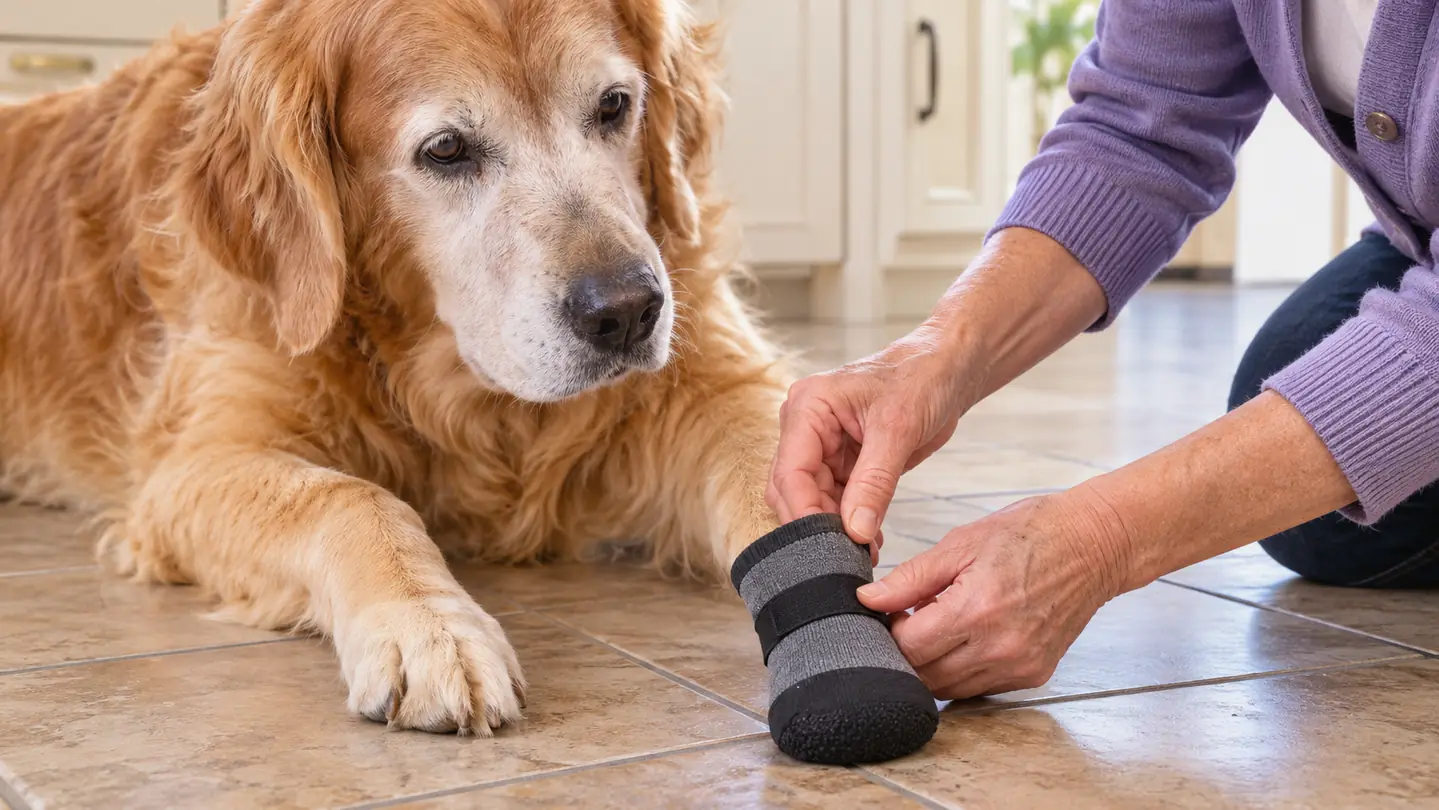
Off at night for a simpler reason. He sleeps on carpet in the bedroom and there is no problem to solve there. On again in the morning, when he comes into the kitchen and the tile starts. The whole routine takes about thirty seconds and he now stands still for it, which he did not do in February. The first week it took two of us, in the sense that I needed one hand under his chest and one on the cuff, and it went faster once I stopped hurrying.
Washed weekly, sometimes twice, in with a regular load and dried on low. Nine months of that and the cotton and nylon blend has gone a little softer at the cuff. One sock has a small pull in the knit near the toe that has not grown since I first noticed it in June. No seam has let go. The hook and loop strap still holds where it did on day one.
The part that surprised me was the speed. Somewhere around day three or four he walked from the hall into the kitchen without the pause. Not a trot, nothing dramatic. Just a normal walk, straight through the doorway to the water bowl. I had grown so used to the hesitation that watching it disappear felt strange, and I want to be careful here, because I am describing a change in how he crossed a floor and not a change in his hips.
Why Tile Is the Hardest Surface in This House
People hear slippery floors and think of polished hardwood. Glazed tile is worse in a way that is hard to explain unless you have sat and watched a big dog on it. Hardwood at least gives a little under a paw. Tile gives nothing. The pads cannot dig in, and a dog with sore hips cannot afford to spend his balance on staying upright, so the whole floor becomes a place he would rather not go.
There is a second part to it. A dog that slips once starts to expect to slip. Murphy went through a stretch in January where he would not come into the kitchen at all if I had water running at the sink, because the last time he hurried in, his back end went out from under him and he scrambled. That is a behavior problem sitting on top of a joint problem, and it does not get better because you bought a supplement. I spent three weeks walking him the long way around through the front room so he could reach his bowl without touching tile, which is not a solution anybody can keep up.
My hall is about four feet wide and runs twelve feet from the front room to the bedrooms, and every bit of it is the same tile as the kitchen. So this was never a matter of one bad doorway. It was a strip he had to cross three or four times a day whether he wanted to or not.
Your vet can tell you what is happening inside the joint. Mine did, in January, and I am not going to pretend a sock changes any of that. What a sock changes is the surface. That is a small thing. It is also the only thing in this house I could adjust without a prescription.
What the Grip Does When the Sock Twists
Most dog socks fail in the same way. The dog walks, the sock rotates, and the grip ends up on the side of the paw where it does nothing at all. The dog is now wearing a sock that is worse than no sock, because smooth cotton on tile is slicker than a paw pad on tile. Every review I read before buying mentioned twisting, and most of them mentioned it as the reason they gave up.
The DOK listing claims the grip is built to work even when the sock twists. I read that as marketing language and bought them anyway, because the alternative was another round of stick-on toe grips and I had already been through that once in January. Nine months later I will say the claim holds up better than I expected. The socks do twist. Murphy's front left rotates about a quarter turn by the end of a day. But the grip still contacts the floor after that quarter turn, and he keeps his footing.
I want to be honest about the edge of it. On a day when a sock has rotated further than that, I see him adjust his stance, and once in a while he sits down and waits for me to fix it. That happened twice in August and once in October, both times after a long nap when the cuff had worked loose. But I have not seen a full slip on the tile since the first week, and in January I was seeing one or two a week.
The socks do twist. A quarter turn by the end of the day, most days. The grip still meets the floor, and Murphy still keeps his footing.
The Honest Parts: Chewing, Twisting, and Laundry
He chewed at them for the first two days. Not seriously, more the way he worries at something that feels wrong on his foot. I took them off, put them back on a few minutes later, and by the third morning he had quit bothering. If you have a dedicated chewer, that adjustment may go differently, and I would not leave a determined chewer alone in a room in them for the first week.
They twist. I have said it twice now because it belongs on the list of things you are actually buying. Expect to straighten a sock once a day. It takes five seconds, it is not really a defect, and it is what any fabric on a moving paw will do.
They need washing. Weekly in this house, because a dog in socks on tile is a dog in socks on the same tile he crosses after coming in from the yard. Machine wash per the care instructions, and nine months in they have survived it with the grip intact. If laundry timing is not your strength, a second set solves it, because a day without them is a day the doorway hesitation comes back. I found that out in June, when I left the set in the dryer overnight and he went back to stopping at the doorway by the second morning.
And they will not stay on a dog who has decided they will not. The cuff is a hook and loop strap over a pull-on sock, and it holds on Murphy at 71 pounds. A dog who has genuinely made up his mind to remove them can do it. The first week is the whole battle, and there is no way around that except through it.
What These Socks Don't Do
They do not treat arthritis. They do not support a joint, deliver an ingredient, or slow anything down inside a hip. If that is what you are shopping for, the conversation belongs with your vet and not with a sock listing. Murphy takes a daily joint chew and two other supplements his vet approved, and none of those is a cure either. They are management, and so is this.
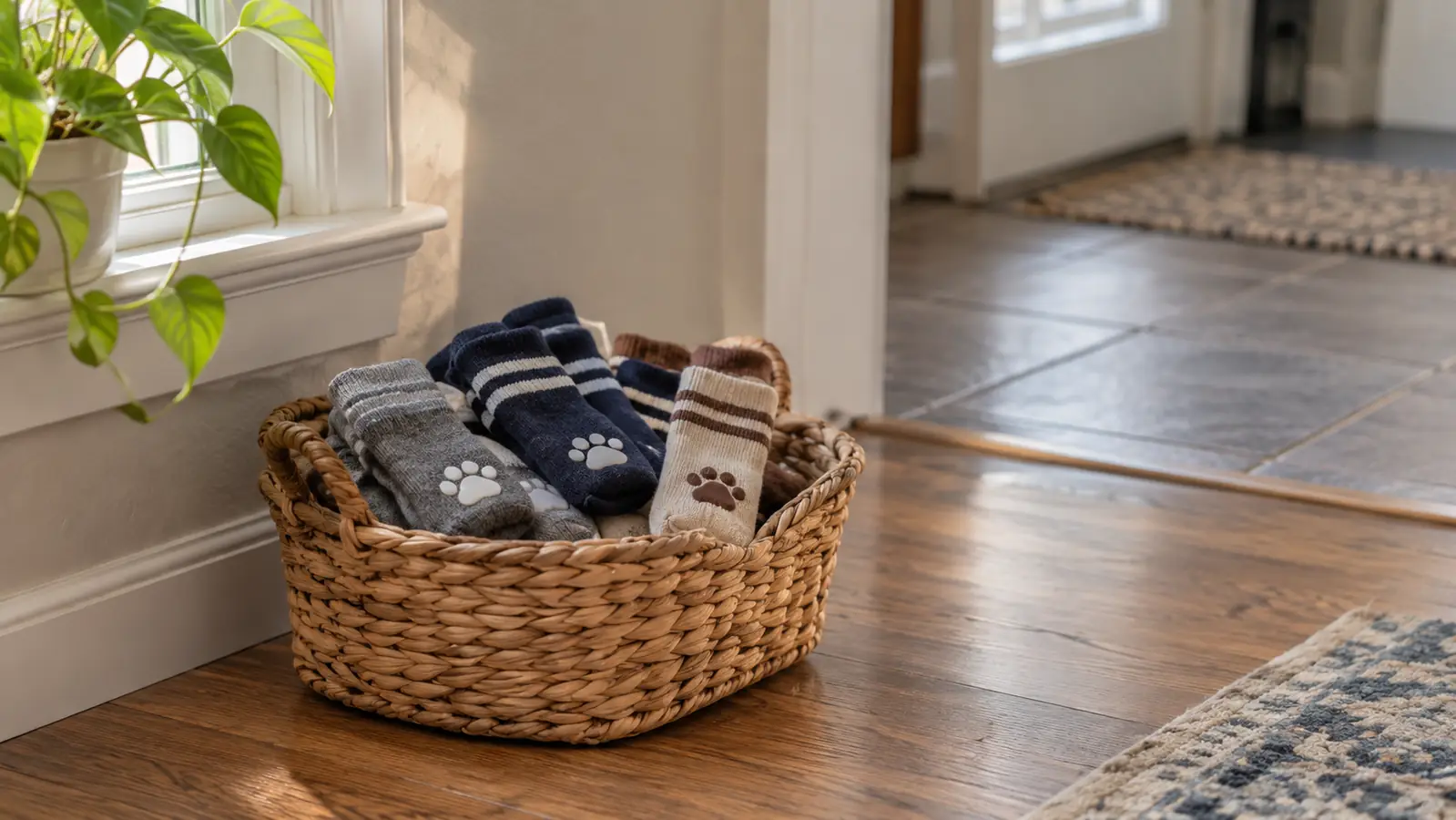
They are not for outdoors, whatever the listing's mention of outdoor protection suggests. Concrete eats fabric. For the two steps at my back door and for getting him into the RAV4, I use a rear support sling, because lifting is a different job from traction and one tool does not do both. The socks live in a basket by the hall and they stay indoors.
And they are not a substitute for watching how your dog gets up. Murphy still has rough mornings. The socks mean he has rough mornings on a floor that is not fighting him at the same time. That is the entire claim, and I think it is worth being clear about it, because it is a smaller claim than most product pages make and a more useful one.
What I Tried Before Them
Stick-on rubber toe grips, in January. Two popped off in the first week and the rest collected hair and grit until they stopped gripping anything at all. I know people who swear by them and I believe those people. On Murphy's feet they were a two week experiment and a waste of an afternoon.
A bath towel under the belly for the back steps, which slid out from under him the first time and frightened us both. That got replaced in April by a proper rear support sling, which is a sturdier tool for a different job than this one.
A rubber-backed runner down the middle of the hall, in January, before any of this. Two of the four corners curled within a month and it became its own trip hazard. I rolled it up and put it in the garage, and I have not missed it.
The socks are the only one of those I have kept on him daily for nine months. That is the clearest thing I can tell you about them.
What I Liked
- Grip keeps working after the sock rotates, which is the failure that ends most dog socks
- Nine months of weekly machine washing with no blown seams
- Four socks to a set, so one lost sock is not a lost set
- Hook and loop cuff held on a 71 pound dog through a full day
- The hesitation at the kitchen doorway stopped inside the first week
Where It Falls Short
- They twist, and you will straighten one most days
- Two days of chewing at them before he accepted them
- Not for walks, concrete, or a gravel driveway
- Weekly laundry, and a second set is worth owning
- Does nothing for the joint itself, only the floor
Who This Is For
An older dog on hard flooring who has started to hesitate at the same doorway he used to charge through, and an owner who has already had the hips looked at. If the slipping is new, get the vet first and deal with the floor second. This review is about the floor half of that order, and only the floor half.
It also suits a dog who needs paw protection indoors, or a dog who will not leave a paw alone and needs a physical barrier over it while something else is being sorted out. The listing mentions licking and paw protection, and a sock does cover a paw, which is a plain mechanical fact rather than a medical one.
Who Should Skip It
A dog who will not tolerate anything on his feet after a fair week of trying. A household with wall to wall carpet, where this solves a problem you do not have. A dog whose slipping has not been looked at by a vet yet, because socks on an undiagnosed problem is putting a rug over a crack. And anyone hoping socks will stand in for a joint supplement, a vet visit, or a support sling on the stairs. The DOK TigerToes do not replace any of those and the listing does not claim they do.
Nine months, one basket by the hall, and a dog who walks into the kitchen again
Size Large fits paws 2.5 to 2.8 inches across. Four socks per set, cotton and nylon, machine washable, hook and loop cuff. Measure the paw on paper before you order, because the fit is the whole thing.
Amazon Check Today's Price on Amazon →