
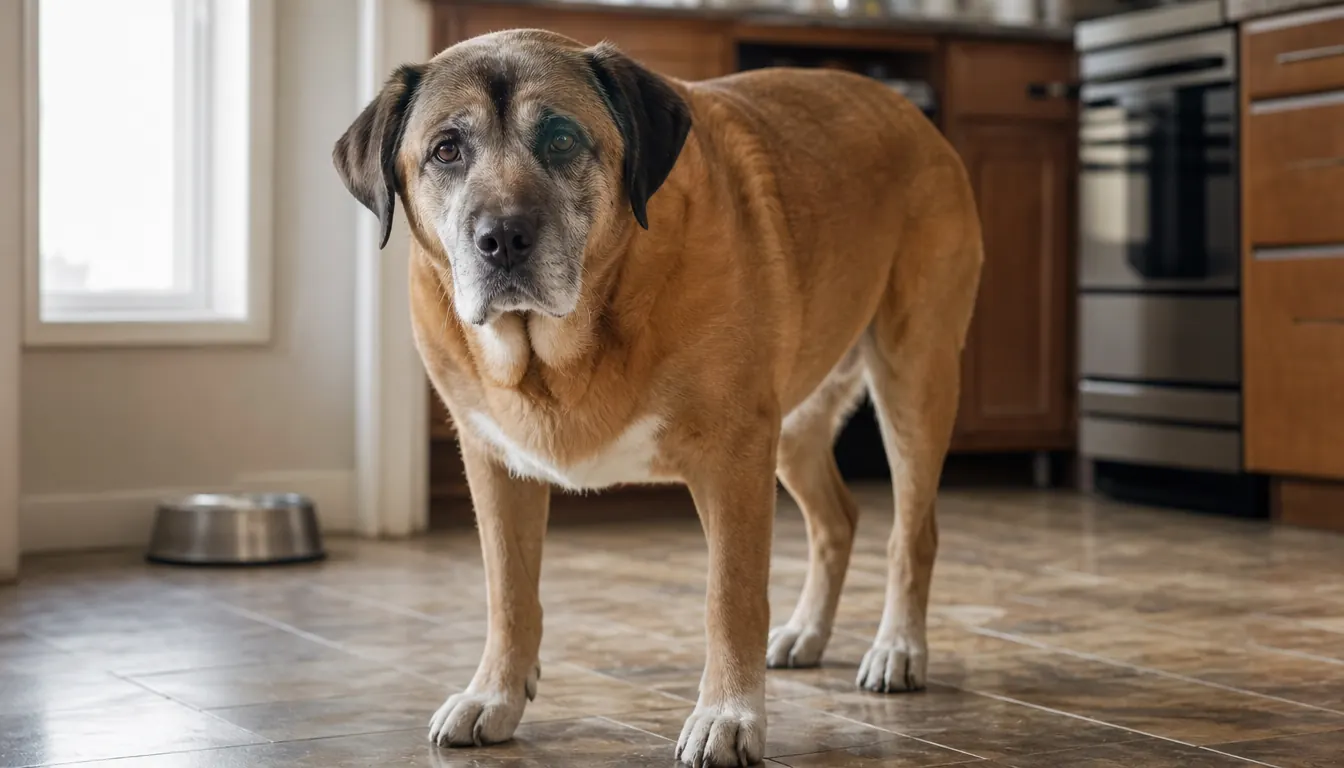
I bought DOK TigerToes dog socks in February 2026 because my dog went down on the kitchen floor twice in one week. Not a tumble on the back steps. Not a slide on wet grass. Just a rear leg folding under him on tile he had crossed ten thousand times without thinking about it. Murphy is a 10 year old golden retriever mix, 71 pounds, and his vet had found arthritis in both hips a few weeks before that. I am not going to tell you a sock treated anything. It did not. What I will tell you is that a specific, repeatable, everyday thing stopped happening in my house, and that is the whole of the claim I am making.
This is the honest version, so it spends as much room on the awkward parts as the good ones. I bought my set of four myself, size Large, and nobody sent me a thing. Nine months later they live in a basket by the hall and go on his feet after breakfast. I have washed them weekly since, which is somewhere north of thirty washes. I have also watched them twist sideways, watched him chew the strap for two solid days, and measured his paws badly enough the first time that I had to start over. Here is what I would tell a friend in the school parking lot.
The Quick Verdict
The grip claim survives real tile, even after the sock rolls sideways. Sizing is fiddly and the strap takes a week to learn. Traction only, no joint claim, and never a substitute for your vet.
Amazon Check Today's Price →The first thing that worked for Murphy was not a supplement.
Nine months in, a set of four socks is still the change I would make first. Measure a front paw with your dog standing and weight bearing, then match that number to the size chart on the listing before you order anything.
Amazon Check Today's Price on Amazon →What Arrived and What the Listing Says
The order held four socks. Not two, not three and a spare. Amazon lists the set at 3.53 ounces and 7 by 3 by 0.25 inches folded, which is a fair description of a flat bundle of fabric about the size of a paperback. The material is cotton and nylon, and the care instruction is machine wash, which I have now tested more than thirty times without a seam letting go.
The grip is the part that matters. It is a thick pad run under the paw, not the light dotted print you see on the thin socks sold in multipacks, and the listing claims three times more grip and grip that works even when the sock twists. I read that second claim as marketing the first time through. Nine months later I read it as a description.
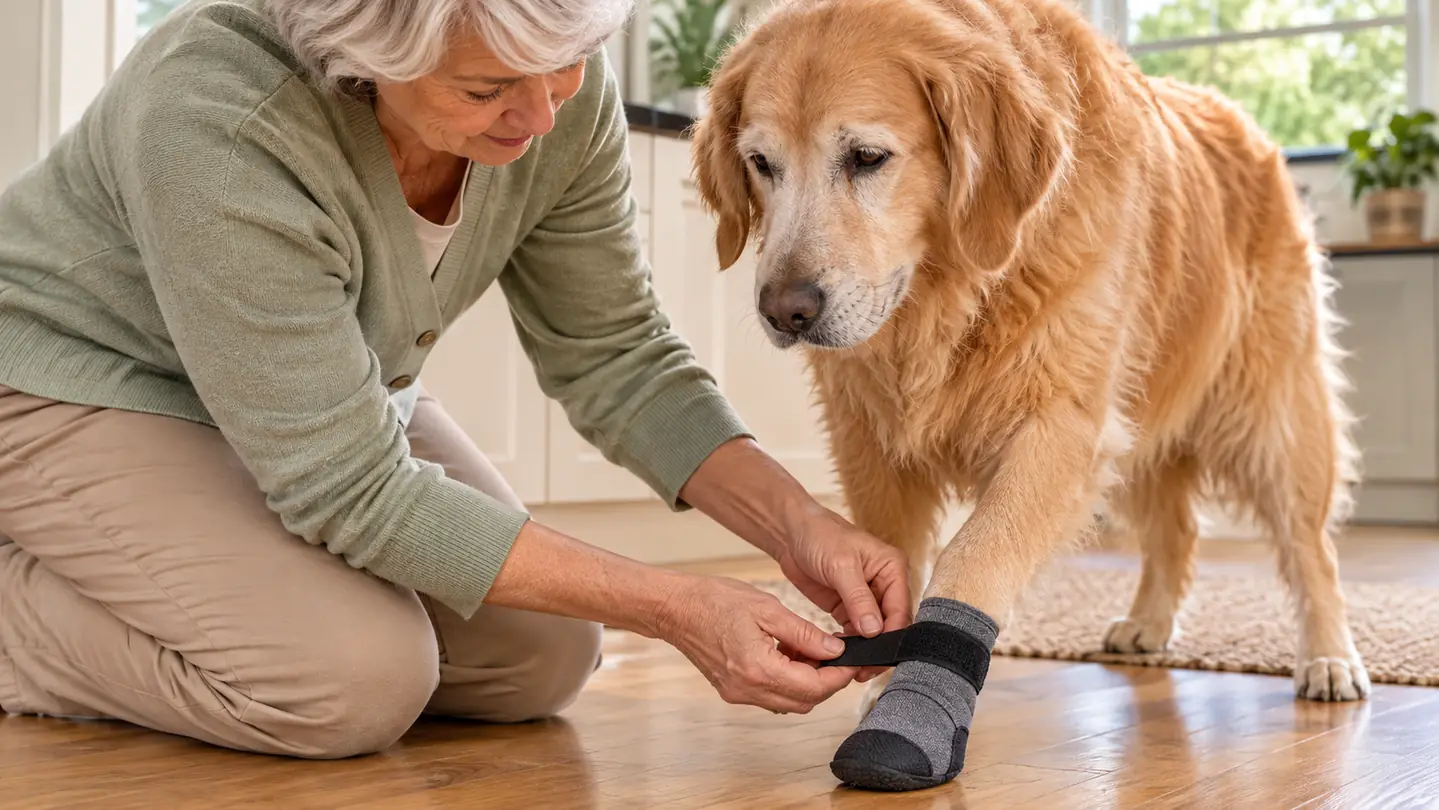
Two details sit on the sock itself. The closure is a hook and loop strap with a pull-on fit, so the sock goes over the paw and then the strap comes across the top of the foot. And the sizing is specific: Large is built for paws 2.5 to 2.8 inches across. That number is the whole purchase, and I will get to why.
The Size Chart Is the Entire Purchase
I got the measurement wrong the first time. I put a tape across Murphy's paw while he was lying down, which is the wrong way to do it, and came up with a number that put him between sizes. Then I did it again the right way, standing, weight bearing, with a treat on the kitchen counter to keep him square. Large is the 2.5 to 2.8 inch range and that is where he landed, though not by much.
If your dog sits at the top of a range, the strap does the rest of the work. The hook and loop band tightens down enough to hold a sock on a paw that runs a shade over the line, and I know that because his rear paws measure wider than his front ones, which is ordinary in a big dog with hip arthritis who shifts weight forward.
What I would not do is guess. A sock that is too small rolls off inside ten minutes and you blame the product. A sock that is too big bunches under the pad and the grip lands in the wrong place. Take the two minutes. Measure all four paws. Write the numbers on the back of an envelope like I did.
How They Fit Into an Actual Day
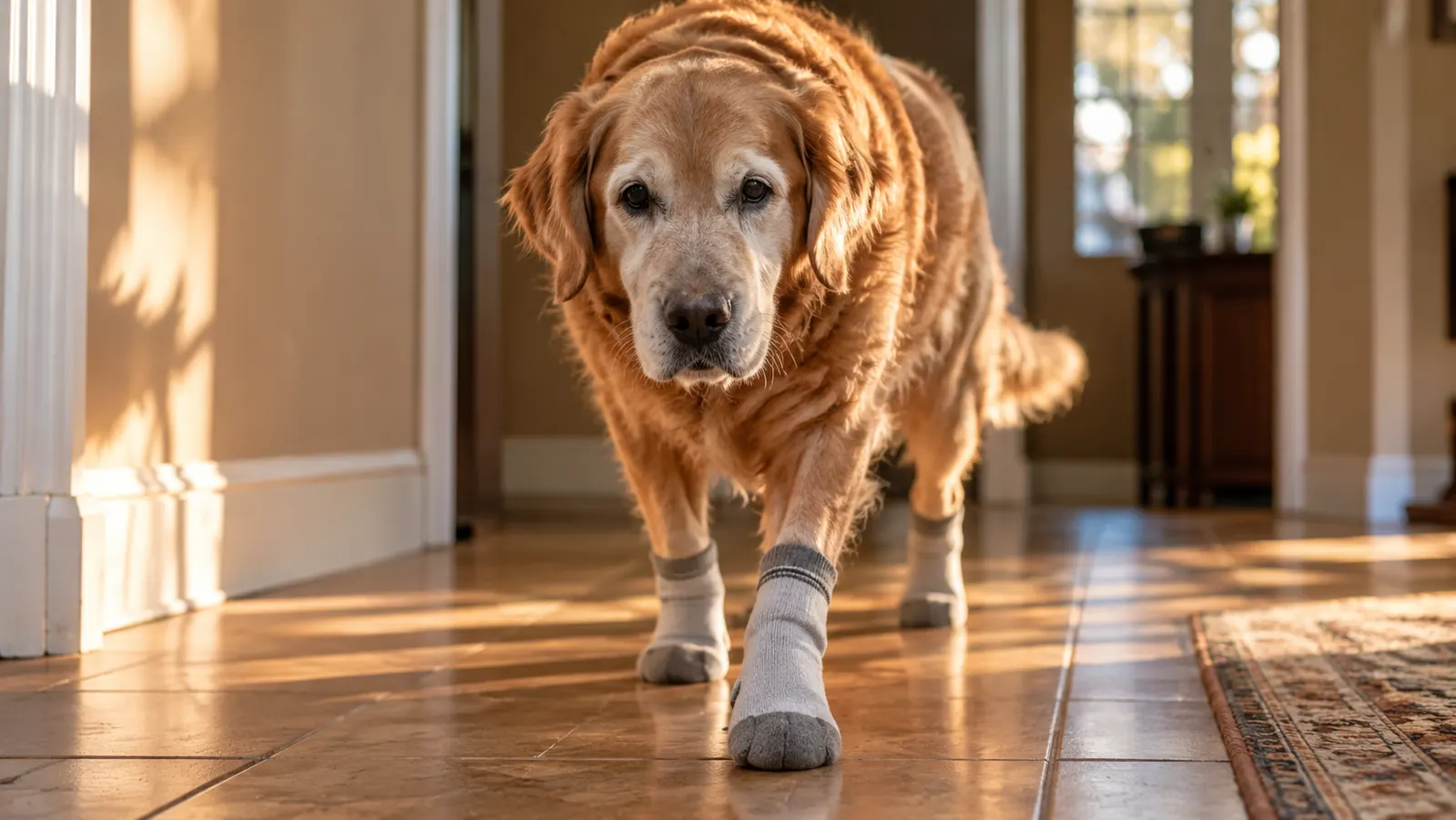
The routine is dull, which is how you know it stuck. Socks go on after breakfast, once he has eaten and been out to the yard. They come off at bedtime. They come off for walks, because in this house they are indoor traction and I am not sending a dog out onto a sidewalk in fabric. They also come off when he is going to be alone and restless, though that has less to do with the socks and more to do with him.
The first two days he chewed at the strap. Not the sock, the strap, the way a dog worries at a bandage. I took them off, let him settle, put them back on twenty minutes later, and by the third morning he had stopped noticing them. If your dog is a determined chewer I would not leave him unattended in them at first. That is true of anything you fasten to a dog.
Washing is once a week, in with a normal load, then air dried on the counter because I am not putting anything rubber through a hot dryer. Thirty odd washes in, the pad still bites on tile and the cotton has not gone thin at the toe. The strap has picked up a little fuzz, which is cosmetic and not worth a paragraph except that I promised you the awkward parts.
The Twist Claim, Tested on My Kitchen Tile
Here is the thing about a sock on a dog. It rotates. It does not stay squared up on the paw the way it does in a listing photo, and any product that pretends otherwise is selling you a picture. On Murphy the front socks hold their position reasonably well. The rear ones roll outward within an hour, especially on the hip that bothers him more, which is the leg he drags slightly when he turns.
So the question is not whether they twist, because they twist. The question is whether grip survives the twist, and on my tile it does. The pad is thick enough and wraps far enough around the sole that even a rolled sock still puts rubber down when his weight comes onto the foot. That is the single design choice that separates DOK TigerToes from the thin socks I tried for about a week and gave up on.
Two honest limits. On carpet they are pointless, and I take them off in the bedroom because they cost him nothing there and gain him nothing. On the two concrete steps at the back door they help a little, but a sock is not a solution for a step. That is a separate job and I handled it separately.
The slipping stopped in the first week. The arthritis did not go anywhere. Those are two different sentences and I am not going to blend them.
What Nobody Tells You Before You Buy
First, you are buying four socks, and four is exactly the right number until one disappears behind the dryer. Then you have three, which is useless. I have not lost one yet, but I count them when I fold laundry, which tells you I have thought about it.
Second, the strap has a learning curve. By day three I could do all four in under a minute. The first morning it took me five, with a dog standing in the hall wondering why I was fussing with his feet. Put them on while he is standing rather than lying down, and go front to back so he can see what you are doing.
Third, and this is the part I would want somebody to say out loud: these are traction, not treatment. Nothing in a sock touches a joint. My dog takes a daily joint chew, a fish oil soft gel that his vet approved, and an afternoon mussel chew, and I cannot prove which of the three did what. The socks are the reason he stopped sliding on the hall tile. They are not the reason his hips are better, because his hips are not better. They are managed.
Fourth, the listing mentions preventing licking and protecting the paw. I have never had a licking problem with Murphy, so I cannot tell you whether the socks stop a dog from going at a hot spot. I can tell you they cover the paw, and a covered paw is harder to get at. That is as far as I will go on that one.
Nails, Fur and the Rest of the Paw
Two things affect how well any sock grips and neither of them is the sock. The first is nails. A dog whose nails are long enough to click on tile is walking on his nails rather than his pads, and the pad is where the grip lands. Murphy gets his done every six weeks, more often since January, and the change in how he stands afterward is not subtle.
The second is the fur between the pads. A golden mix living in California does not grow much of it, but what he has gets trimmed with a rounded pair of scissors every couple of weeks so it does not push the sock up off the sole. If your dog carries a heavy coat on his feet, this matters more, and a groomer will handle it in five minutes if you would rather not.
None of that is a product feature. It is the maintenance around the product, and it is the difference between socks that work and socks you keep taking off to re-seat. I would rather say it plainly than let you order four socks and wonder why they spin.
Where They Fall Short
In January, before these, I tried rubber toe grips, the kind that cap each nail. Two popped off in the first week, one in the yard and one somewhere in the hall that I never found. A DOK sock covers the whole foot, which is why it stayed on and the grips did not. If you are weighing the two against each other, that is the honest difference: coverage, not stickiness.
The socks are not dignified and they are not invisible. A 71 pound dog in four socks looks like a dog in four socks. He does not care. Visitors comment. I answer the same question every time, which is whether they work, and the answer is yes on tile and no on carpet.
The last limit is the dog himself. If your dog panics when his feet are handled, this is not the place to start working on that. Four straps a day on a dog who fights you is a bad trade, and I taught enough nervous teenagers to know that forcing a thing is how you make it permanent. Start with one sock, one paw, ten seconds, and build it over a couple of weeks.
What I Liked
- Grip holds on tile even after the sock rolls sideways
- Four socks in the set, cotton and nylon, machine washable
- Hook and loop strap holds a paw that sits at the top of its size
- Stayed on through nine months and more than thirty washes
- Chewing at the strap stopped after two days
Where It Falls Short
- Sizing must be measured standing and it is easy to get wrong
- Rear socks roll outward and stay rolled
- No benefit on carpet or grass
- Traction only, nothing here touches a joint
- One lost sock leaves you with three
What I Can and Cannot Credit Them With
I want to be careful here, because this is where dog product writing usually goes crooked. Murphy takes a joint chew every morning, a fish oil soft gel with breakfast, and a mussel chew around noon. Dr. Sandoval cleared all three before I added each one. Because three things overlap, I cannot tell you which one made him quicker getting up in the morning. I can tell you the socks are the only item in that routine I could take off and put back on and see a difference inside an hour.
The test was simple. February, tile hall, socks off for an hour. He slipped twice turning around at the water bowl. Socks on, same hour, same floor, no slip. That is not a study of one dog. That is a demonstration in my own hallway, and it is the most honest evidence I have to hand you.
Who This Is For
This is for the owner of a big dog on hard flooring who has watched a rear leg slide out and felt their stomach drop. It is for a dog with a diagnosis, or a dog heading toward one, who is still walking and still getting up on his own. It is for someone willing to spend four minutes a day putting socks on and taking them off, and to measure a paw properly before ordering. If that describes your week, a set of DOK TigerToes is the cheapest piece of the routine to test, though I am not going to quote you a number.
Who Should Skip It
Skip it if your floors are carpet. Skip it if your dog will not tolerate his feet being handled and you are not prepared to teach that slowly. Skip it if you are looking for something that helps the joint itself, because this does not and no sock will. And skip it if you want a product that looks tidy all day, because a sock on a dog's foot does not stay tidy. It stays on, which is a different and better thing.
Measure the paw. Then decide.
Nine months, more than thirty washes, one set of four still in the basket by the hall. Size Large covers paws 2.5 to 2.8 inches. If your dog sits outside that range, read the size chart on the listing before you order.
Amazon Check Today's Price on Amazon →