
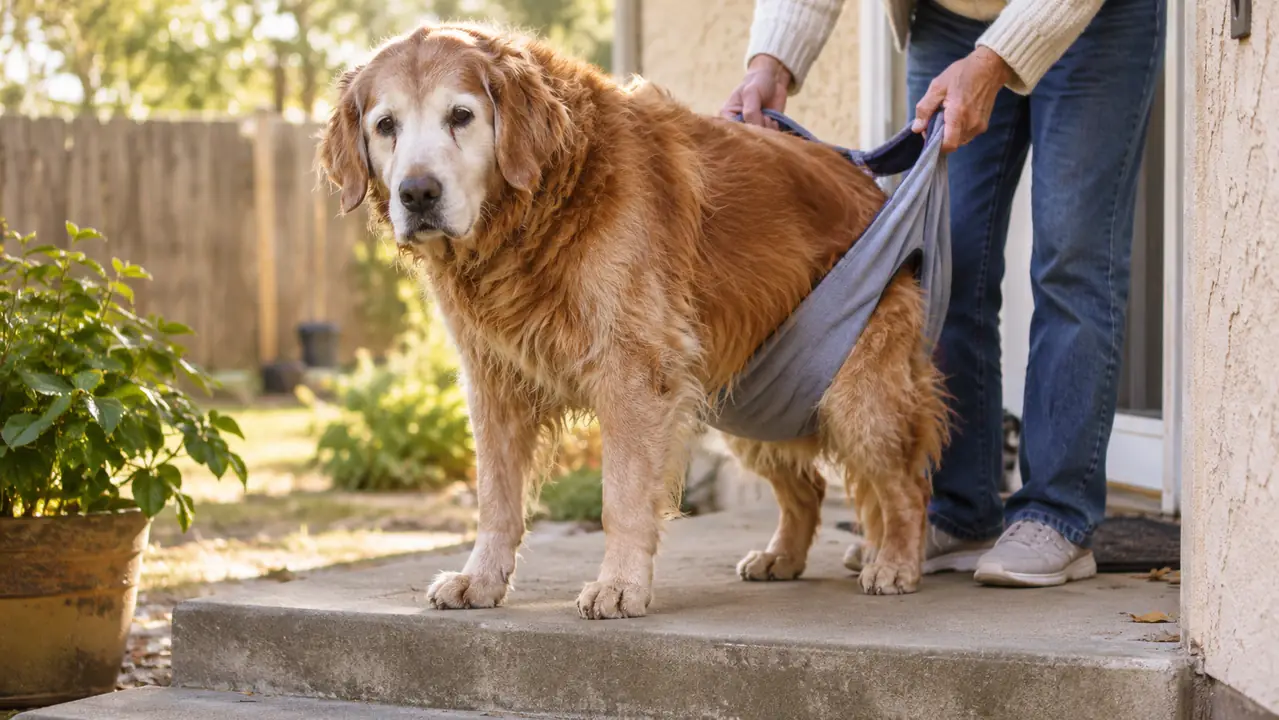
I bought the LOOBANI dog lift harness in April 2026 because of two concrete steps. Not a figure of speech. Two actual steps at the back door of my house in Redlands, California, each about six inches tall, going down to a fenced yard. My dog is a 10 year old golden retriever mix named Murphy, 71 pounds, and in January 2026 his vet diagnosed arthritis in both hips after he started stopping at the top of those steps and looking at me instead of going down.
For three months I got him down with a bath towel under his belly. It worked maybe seventy percent of the time. The other thirty percent the towel slid, bunched into a rope, or shot out from under him entirely and he sat down hard on the concrete. So this is not going to be a review telling you the LOOBANI sling gave me my dog back. It did not, and any page that promises that is selling you something the product cannot deliver. What it did was solve one narrow, grinding problem that had both of us dreading the back door. I have used it seven months now, most days twice. Here is what I wish someone had told me first.
The Quick Verdict
A sturdy rear-end sling that does exactly one job and does it well. It is not a harness, it will not help his hips, and it took me a week to get the fit right.
Amazon Check Today's Price →The thing that got us down the back steps without a towel
Rear-end support for a dog who needs a hand, not a full body harness. Read the size chart against your dog's weight before you order, because the fit is the whole ballgame.
Amazon Check Today's Price on Amazon →How I've Used It, Seven Months In
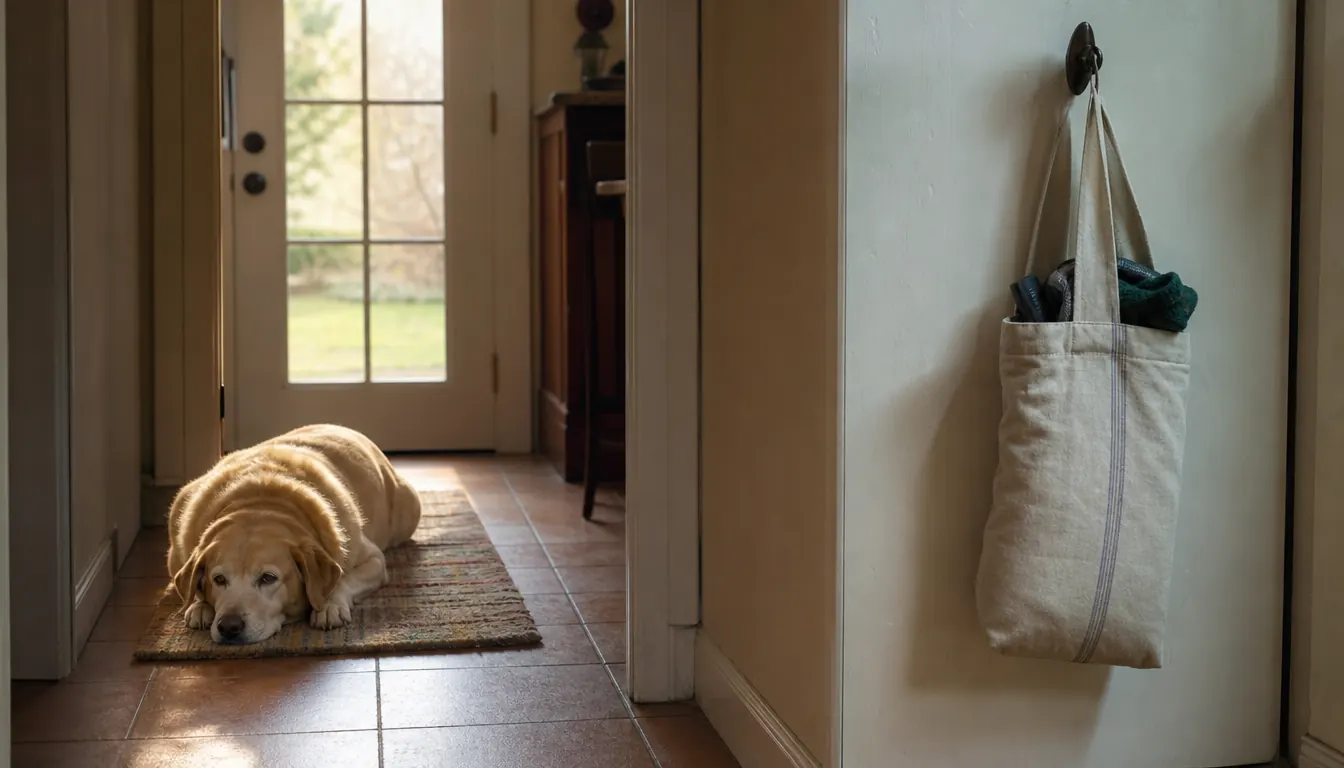
The sling hangs on a hook by the back door at about shoulder height, where I can reach it without bending. That placement matters more than it sounds. If the sling lived in a drawer I would not use it at six in the morning when Murphy is standing at the door looking at me and my own back has not warmed up yet. The listing says it folds into a storage bag and it does. The bag lives in the back of my 2019 RAV4 for vet days. At home it stays on the hook.
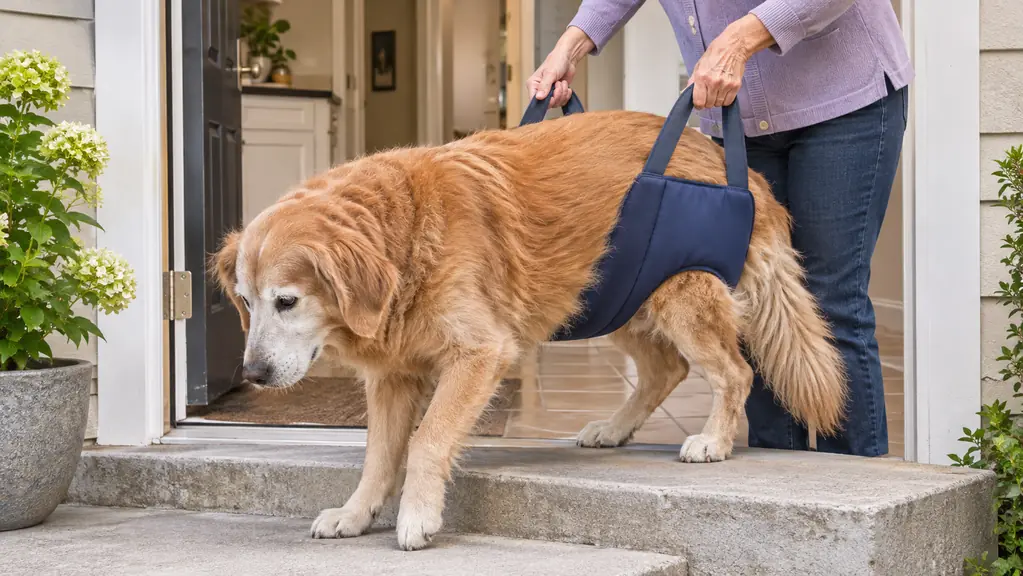
Using it takes about four seconds once you know how. The padded panel goes under his hips, in front of the hind legs rather than behind them, and the two handles come up at my sides. I take a handle in each hand, or both in one hand if I need the other on the door frame, and I take his weight as he steps down. He does the stepping. I do the steadying. That division of labor is the entire reason this works better than the towel did. The towel took his weight and slid with it. The sling takes his weight and stays where I put it.
For the RAV4 it is the same motion in reverse, except I am lifting rather than lowering, and I do it before he starts to try. If I wait until he is already halfway up with his front paws on the bumper, it is too late and I am no help to him. The sling goes on first, then he puts his front feet up, then I take the rear and we go together. Seven months in, he stands still for it. He did not the first week.
The first car trip with it was a Thursday in April, a recheck with Dr. Sandoval, and I made a mess of the sequence. I let him get his front paws on the bumper before I had a grip on the handles, and he stalled there with his back legs on the pavement and his whole rear end sagging. I set him back down, put the panel on properly, and started over, and we were both a little rattled by the time we pulled out. Now I park with the tailgate facing away from the curb so he steps up level instead of climbing, and I put the sling on while he is still standing square on flat ground. That one change did more for us than anything else I learned in April.
What the Listing Does Not Say Out Loud
The product page calls this a lift harness. It is not a harness in the sense most people mean when they say that word. It is a sling. It goes under the hips and supports the rear end only. Nothing crosses his chest, nothing goes around his shoulders, and there are no straps running along his back. I say this plainly because I have read more than one complaint from a buyer who expected a full body harness and received this instead, and the disappointment was in the expectation, not in the stitching. If your dog needs support in front, this is the wrong product, full stop.
The material is nylon, the closure is a drawstring, and the part that sits against the dog is a soft fleece like lining over a thicker padded section. In July in Redlands I worried about heat under that panel. I checked the skin beneath it after walks twice a week for the first month and never found a rub, a hot spot or a raw patch. It is machine washable and it has gone through my machine weekly since April. The fabric has dulled slightly. The padding has not flattened and the seams have not opened.
I wash it on Saturday mornings with the dog towels, cold water, regular cycle, and I hang it over the laundry sink instead of putting it in the dryer. I do not trust heat against the padding and I have no intention of finding out the hard way. It is dry by mid afternoon and it goes straight back on the hook. Four months of that and the drawstring still ties the way it did on day one. The fleece like lining has gone a little flatter than it was in April but it has not pilled and it has not shed.
One thing the listing does not spell out: this sling is only as good as your grip on the handles. They are nylon loops, comfortable enough bare handed, but if you have arthritis in your own hands the way I do, a pair of work gloves helps on days when you are carrying weight for a longer stretch. That is not a defect in the product. It is just a fact about lifting things with your hands at sixty eight years old.
The Week I Almost Sent It Back
The first four days were bad and I want to be honest about why. I had the panel too far back, almost behind his hind legs, and when I lifted I was mostly lifting air. He felt nothing useful, he did not trust it, and he braced and refused to step. On day three I stood in the hallway for ten minutes with the sling in my hands and the return label open on my phone.
What changed it was the drawstring. I pulled it snug and set the panel further forward, in front of the hind legs and under the widest part of his hips, and suddenly there was something to lift. The second thing that changed it was me shutting up. I had been talking to him in that bright encouraging voice I used in thirty one years of teaching gym, and it was making him worse. I went quiet, took the weight, and waited. He stepped. That was the whole fix. The product was fine. The operator needed retraining, which is a thing I have said about myself before.
The Sizing Question Nobody Answers Well
Size X-Large is what I ordered for a 71 pound dog and it is roomy on him. Not sloppy, but there is slack in the panel, and I suspect a 55 pound dog would fit the same sling with the drawstring cinched up. The listing hands you size names and a weight range, not a hip measurement, and hips are what this thing actually has to fit around. If your dog sits between sizes, or is a shape that does not match his weight, measure him and ask the seller before you order. I did not have to. I would have if Murphy had been 90 pounds.
What I would do differently, and what I would tell anyone ordering today: run a tape measure around the widest part of your dog's hips, write the number down, and message the seller with that number and his weight before you buy. I did not know to do that in April. I ordered on weight alone, it worked out, and I am honest enough to say that was luck as much as judgment. A dog who is long in the back, or narrow through the hips for his weight, is exactly the case where a size name stops being useful to anybody.
The drawstring is how you snug it. Pull, tie, and the panel stays where you set it instead of creeping back toward the tail. Set it too far back and you will feel his hips slipping through it as you lift. Set it too far forward and you are hoisting his belly, which is not the job and does not help him down a step. A week of daily use got me to the right spot. It was not obvious to me on day one and I do not think it would be obvious to most people.
What It Does Not Do
I want to be direct here, because this is where I think buyers get hurt. The LOOBANI sling does not treat arthritis. It does not strengthen anything, it does not slow the disease, and it does not make his hips better. It is a piece of equipment for moving a dog from one place to another without either of you getting hurt. That is all it is, and it is enough. Murphy's hips are managed with what Dr. Sandoval prescribed and approved, including the daily joint chew he has taken since January. The sling belongs in the same category as the handrail on my own front steps. A handrail does not cure a knee. It keeps you off the floor.
It also does not replace a veterinarian. If your dog is dragging a hind leg, knuckling over on the top of his foot, or losing bladder control, that is not a sling problem, that is a phone call the same day. I taught high school health for thirty one years and I am not a vet. I have no business diagnosing anything, and neither does a product page. What I can tell you is what a sling did and did not do in my hallway.
And it does not do distance. I tried it on a full park walk once, thinking I could take some weight off him for the whole twenty minutes. That was a Tuesday in June, about a quarter mile in, and I spent the next ten minutes walking half sideways so the sling would not twist. He pulled left, the panel crept back toward his tail, and I stopped twice to reset it while he stood there giving me a look. We finished the loop at his own pace with the sling in my hand. It has not been on a walk since.
The handles pull your arm into a strange position when you are walking forward rather than standing at a threshold, and Murphy did not care for the constant pressure around his hips. This is a tool for steps, curbs, the tailgate and the vet's scale. It is not a walking aid and I would not pretend otherwise.
What I Compared It To
The honest comparison is a bath towel, because that is what I actually owned and used. The towel is free and it is better than nothing. It is also unreliable in exactly the moment you need it, and after three months my shoulders had opinions about it. The sling costs money and works every time. That is the trade.
I also read labels on full body harnesses. I have never owned one. I saw one at Dr. Sandoval's office being used on a dog with a rear leg injury, and I read through the listings on a few. From what I can tell they spread support across the chest and the rear, and they are the right choice for a dog who needs help all over. What I wanted was something that hangs by my door, takes four seconds, and does not require me to wrestle anything over Murphy's head before he has had his breakfast. A sling is a smaller tool for a smaller problem. If your problem is bigger than mine, buy the bigger tool.
What I Liked
- Rear-end support that stays where you place it, which a towel never did for me
- Padded fleece like lining, no rubs or hot spots found across seven months of daily use
- Machine washable and it has held up to weekly washing since April without a seam letting go
- The storage bag is genuinely useful for the RAV4 and vet appointments
- Drawstring lets you snug the panel, so one size covers a range of dog shapes
Where It Falls Short
- It is a sling, not a harness. Nothing supports the front end at all
- Sizing runs off weight and a size name, not a hip measurement, and the fit is the whole thing
- Awkward for walking any distance. It is a threshold tool
- Handles put the load through your own hands and wrists, which matters if yours are older
- The fabric has dulled a little after months of washing
The towel took his weight and slid with it. The sling takes his weight and stays where I put it.
Who This Is For
This is for the owner of a large dog whose rear end has gotten unreliable while the front end is still fine. A dog who can walk, who still wants to go, who can stand once he is up, but who hesitates at steps, curbs and vehicles. It is for the person who has already tried a towel and learned what a towel does. It is also, frankly, for the owner whose own back or hands are the limiting factor, because the handles move the load out of your spine and into your grip where you can at least feel it.
Who Should Skip It
Skip it if your dog needs support through the chest and shoulders, because this is the wrong shape for that job and no adjustment will change it. Skip it if your dog will not tolerate anything around his hips, because you cannot argue a sling onto a dog who has made up his mind. Skip it if you are shopping for something that helps his joints, because this is equipment and not medicine, and the decisions that helped Murphy's comfort were made with his vet. And skip it if the only place you would ever use it is on a long walk. Buy it for thresholds. If you buy it expecting a walking aid you will be irritated by the second week, and the sling will be fine the whole time.
One last thing, and I mean it as a teacher and not as a salesperson. Whatever you buy, get the diagnosis first. I spent three months assuming Murphy was just getting old before I took him in. He was getting old. He also had arthritis in both hips, and there were things that could be done about that which had nothing to do with a piece of nylon hanging on my door frame. The sling made our days easier. It was not the beginning of the answer and it is not the end of it.
One job, done properly, hanging by the back door
Rear-end support for steps, curbs and the car. Measure against the size chart before you order, and ask your vet what else your dog needs, because this sling is not one of those things.
Amazon Check Today's Price on Amazon →