
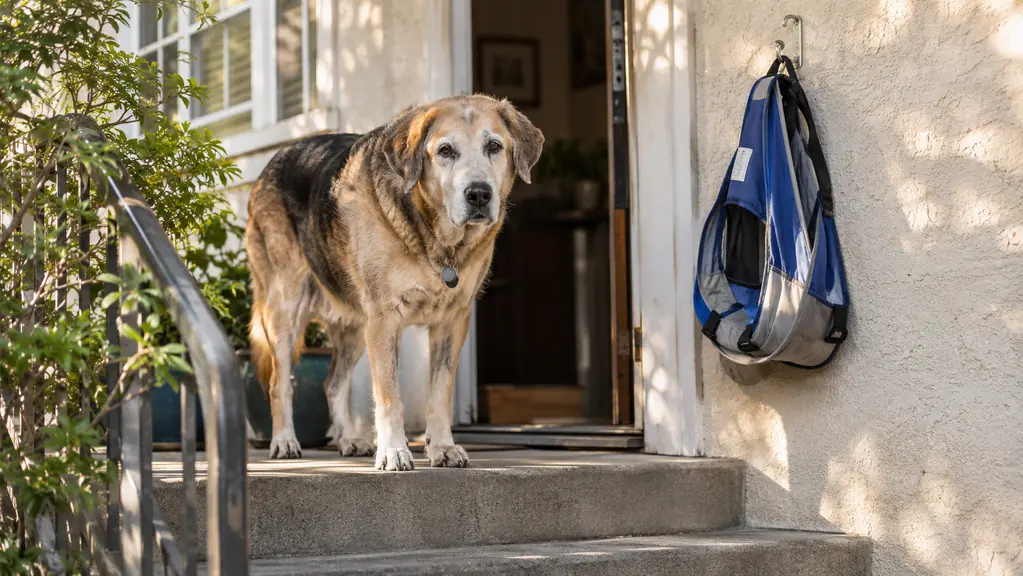
I have two concrete steps at my back door. That is all. Two steps down to a fenced yard, and for eight years Murphy took them without thinking. He is a 10 year old neutered male golden retriever mix, 71 pounds, and he came home as a puppy in spring 2016. In January 2026 his vet, Dr. Sandoval, diagnosed arthritis in both hips. The diagnosis did not surprise me. What surprised me was how the steps turned into a negotiation. He would stand at the top, look down, look back at me, and wait. Not every time. Just on the mornings after a longer walk, or when the tile was cold. I tried a bath towel under his belly. It slid. I tried going first and coaxing. He was not fooled. The fix, for us, was not a full body harness and not a ramp. It was a rear lift sling that shares the load while he does the work. The one hanging by my back door is the LOOBANI Dog Lift Harness, size X-Large. It supports his hindquarters only. It is not a chest harness. That distinction matters more than the brand name, and I will come back to it.
I am not a veterinarian. I taught high school PE and health for 31 years, and I am 68 now. I know how to watch a body move and how to break a movement into smaller pieces. That is what this article is: smaller pieces. If your dog is hesitating at stairs, get a diagnosis first. A sling can help a dog with arthritis, but it can also mask a problem that needs treatment. Dr. Sandoval okayed the sling for Murphy after she watched him walk and stand. She did not okay me carrying him. There is a difference.
The two back steps stopped being a negotiation.
The LOOBANI lift sling supports the rear end while the dog keeps his own footing. Size X-Large, nylon, machine wash, storage bag included. It goes under the hips, never across the chest.
Amazon Check Today's Price on Amazon →Step 1: Get the stairs checked, not just the dog
Stairs are a strength test and a balance test at the same time. A dog has to push up with the rear legs, control the descent with the front legs, and keep his head level while the ground changes under him. Arthritis in both hips makes the push hurt. A slick tile floor at the bottom makes the control uncertain. If your dog is hesitating, do not assume it is only pain. Ask your vet to watch him stand from a down position, walk, and take a step. Murphy's vet did that in the exam room and then talked to me about weight, traction, and what I could safely do at home. She did not promise me a reversal. She promised me a plan.
Dr. Sandoval also checked his nails and the pads of his feet. Long nails change how a dog stands, and sore pads change how he trusts a step. Those are small things, but they are cheap to fix and they change the whole picture. She asked about his weight. At 71 pounds he is not overweight, but every extra pound is a load on arthritic hips. We agreed to keep him there. If your dog needs to lose weight, that conversation belongs with your vet, not with a product page.
I am not going to tell you a sling treats arthritis. It does not. It does not cure anything. It gives you a way to support the rear end while the dog uses his own legs. That is a mechanical job, not a medical one. The medical job belongs to your vet. The mechanical job is where a lift harness earns its place by the door.
Step 2: Fit the sling on flat ground, not at the stairs
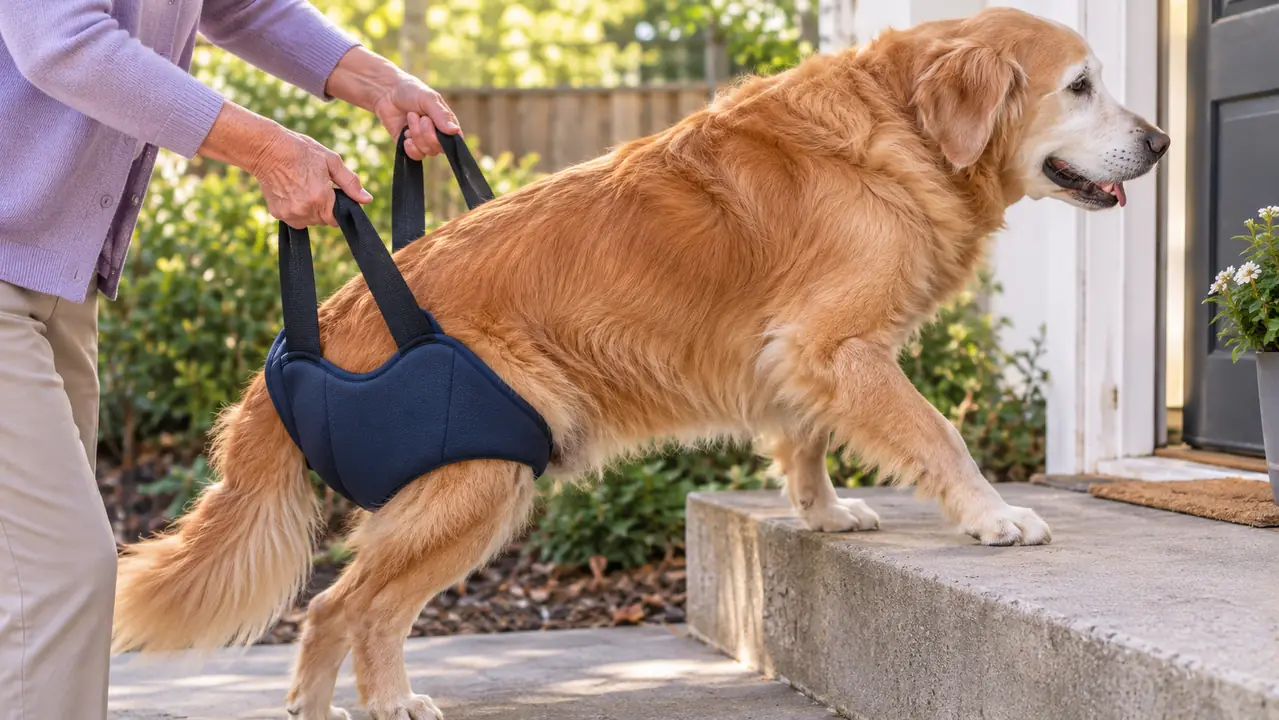
Fit it in the kitchen first. The kitchen has tile, but it is flat and you are not managing a step. I put the LOOBANI sling under Murphy's hindquarters with both of us standing still. The soft sheepskin-like lining sits against his belly and the inside of his thighs. The nylon outer shell is what takes the wear. The sling is size X-Large, which is the size for a large dog, and Murphy is 71 pounds. If the sling is too long, the support sits too low and you end up lifting with your arms instead of sharing the load. If it is too short, it bunches. Check for bunching before you check for anything else.
The sling is rear support only. It goes under the hips, not across the chest, and it does not replace a full body harness. I have never owned a full body harness. I have read labels and I have seen one at the vet, and that is the limit of my experience with them. What I can tell you is that a rear sling is the right tool for a dog who can still use his front end and needs help with the back end. If your dog is weak in all four legs, or if he cannot stand even with help, this is a conversation for your vet, not a sling.
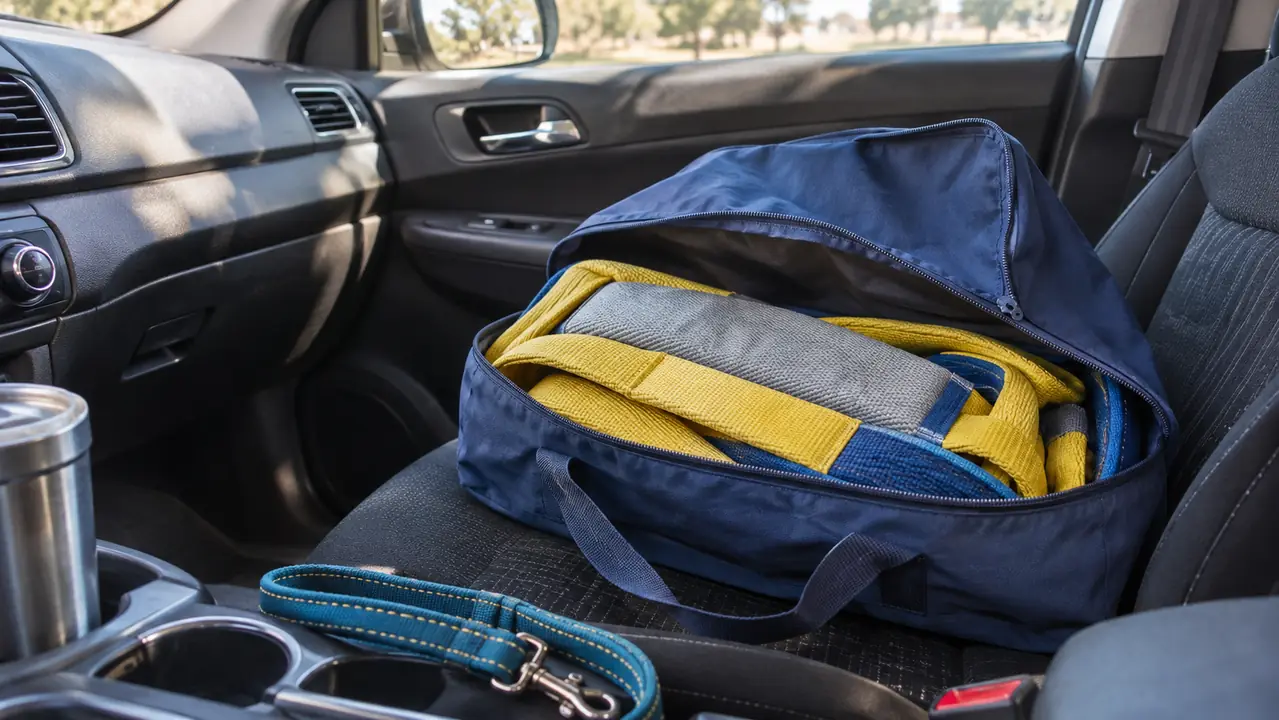
Walk him a few steps on the flat floor with the sling in place and your hand taking only a little of the weight. You are checking three things: does he accept it, does it stay where you put it, and can you hold it without stooping. I bought the LOOBANI sling in April 2026, after the socks and before the mussel chews. It folds into the storage bag that comes with it, which is how it travels in the 2019 Toyota RAV4 on vet days. At home it hangs on a hook by the back door. It weighs 14.88 ounces, so it is not a burden to carry out to the car. Machine wash it when it gets dirty. A dirty sling against a dog's skin is a skin problem waiting to happen.
Step 3: Teach the dog to wear it before you ask for a step
Murphy is not a dog who loves equipment. He tolerated the sling because I did not make it an event. I put it on, gave him a piece of his regular kibble, took it off. I did that twice a day for three days in the kitchen. No stairs. No car. Just the sling and a treat. By the third day he stood still when I reached for it. That is the whole goal of this step. You are not training a trick. You are removing the suspicion that the sling means something bad is about to happen.
Use one word for the movement. I use 'up' for the steps and 'load' for the car. Keep the word the same every time. Do not pull on the sling to make the word true. The sling is there to support, not to drag. If he stops, stop with him. Give him a second. If he still will not move, take the sling off and try again later. A dog who is rushed on the first day will remember it on the tenth.
This is also the step where you check your own body. I am 68. I have a right shoulder that complains if I lift anything above my head. I keep my hand low and I keep my back straight. I do not carry Murphy. I take maybe 20 to 30 percent of his weight and let him do the rest. If you cannot hold the sling without twisting, get a second person or ask your vet for a referral to a rehab therapist. A fall on the stairs with a dog is worse than a slow week of training.
Step 4: Use the sling on the stairs, one step at a time
Going up, I stand slightly behind and to Murphy's left, with the sling under his hips and my hand taking a little weight as he pushes. I do not lift him. I wait for him to commit to the step, then I follow. Going down, I stand on the lower side and let the sling control the rear end so he does not slide. The front end is his job. The back end is mine. That is the division of labor. If your stairs are steep or carpeted in a way that shifts, go slower than you think you need to.
Two steps is not a big staircase, but two steps is where he hesitated. We do them one at a time. I say 'up' and I wait. He steps. I follow. He steps. I follow. At the bottom he gets a treat and we go into the yard. The whole thing takes less time than it did when I was coaxing him. The sling is not a wheelchair. It is a hand that helps. The dog still has to do the work, and that is the point. If he stops doing the work, the sling is not the answer. That is a vet call.
Watch the feet, not the face. You want to see the paw land flat, not knuckled over. You want to see him push, not hop. If he starts hopping on one rear leg, stop and call your vet. If he yelps, stop. If he refuses the step even with the sling, do not force it. A dog who is afraid on the stairs will fight the sling, and you will both end up on the ground. The goal is two calm steps, not a performance.
The towel slid. The sling stayed put. That is the whole reason it hangs by my back door.
Step 5: Make it a routine and know when to stop
The sling lives on a hook by the back door. It goes in its storage bag in the RAV4 on vet days. I use it on stiff mornings, after a longer walk, and every time he gets into the car. I do not use it on the flat floor anymore unless he is having a bad day. The routine is the point. A dog does not have to dread the steps if the steps are the same every time. He gets the sling, he gets the word, he gets the treat at the bottom. That is a predictable sequence, and predictable is calming.
Check the sling the way you check a leash. Look at the seams. Look at the lining. Wash it when it smells. The LOOBANI sling is machine washable, and the storage bag keeps it from collecting dust in the car. I wash ours weekly, more often if the yard is muddy. A clean sling is easier to put on and less likely to rub. If the lining wears through, replace it. Do not sew a patch on a piece of equipment that is holding part of your dog's weight.
Know when the sling is not enough. If your dog cannot stand without it, if he is dragging a rear leg, if he cannot control his bladder, or if he seems painful even at rest, call your vet. Those are not training problems. A sling is a tool for a dog who can still move but needs help. It is not a substitute for pain control, weight management, or a diagnosis. I say that plainly because I have watched Murphy have good weeks and bad weeks, and the bad weeks are not solved by a piece of nylon.
What Else Helps
Traction is the other half of the stairs. Murphy's kitchen and hall are tile. Before the sling, he slipped on that tile when he turned. In February 2026 I put DOK TigerToes on him, size Large, one set of four. They are socks with grips. He chewed at them for two days and then ignored them. They twist sometimes. They still grip. The slipping stopped within the first week. I take them off at night and for walks, and I wash them weekly. Before the socks I tried rubber toe grips in January. Two popped off in the first week. That was the end of that.
The supplements are a longer story, and I cannot prove which one did what. Murphy started Cosequin in January 2026, the soft chews, one with breakfast. I saw nothing the first month. By about week eight he seemed quicker getting up from his bed in the morning. I cannot prove the chew did it. In March I added Nordic Naturals fish oil soft gels, tucked into his breakfast because he will not take one alone. Before the soft gels I tried a pump bottle of salmon oil in February and quit. It was messy and it smelled up the kitchen. By May his coat looked softer. I saw no joint change I could point to. In May I added Zesty Paws Mussel Bites, the chicken and mussel soft chews, given around noon after his walk. I added it because green-lipped mussel is a different ingredient from Cosequin. He waits by the pantry for that one. Dr. Sandoval okayed all three together before I added each one. Doses are what the label says for his weight.
I also shortened the morning walk. We used to do 30 minutes at the park. Now we do about 20, and some days less. That was not a sacrifice. It was a trade. Less distance, more sniffing, more standing in the shade. He seems no worse for it. If your dog is limping after a walk, the walk is too long. That is not a product decision. That is a management decision.
A full body harness is a different tool. I have never owned one, so I will not pretend to compare. I know from reading labels and from seeing one at the vet that a full body harness supports the chest and the rear. The LOOBANI sling supports the rear only. If your dog needs chest support, ask your vet or a rehab therapist. If your dog needs help with the back end on two steps and into the car, the sling is the simpler tool. Dasuquin is another supplement I have never used. I am not going to recommend something I have not tried. I will say that any supplement decision belongs with your vet, especially if your dog is on other medication. The socks and the sling are for traction and lifting. They are not joint supplements, and I do not ask them to be.
Start with the two steps your dog is already avoiding.
The LOOBANI Dog Lift Harness is a rear support sling for a dog who can still use his front legs. Size X-Large, nylon, soft sheepskin-like lining, machine wash, storage bag included. Put it on in the kitchen first. Then take the steps one at a time.
Amazon Check Today's Price on Amazon →