

Murphy started stopping at the top of the two concrete steps behind my kitchen in December. Not falling. Not yelping. Just stopping, looking down at the yard, and taking a second before he committed to the drop. He is a 10 year old neutered male golden retriever mix, 71 pounds, and in January 2026 his vet diagnosed arthritis in both hips.
I am not a veterinarian and I will not play one here. I taught high school PE and health for 31 years, I am 68, and what I know about dog joints comes from reading labels closely and from asking Dr. Sandoval the same question three different ways until the answer made sense. What I can tell you honestly is how I added omega-3 to his mornings, in what order, what I actually saw, and where I stopped guessing. The soft gels I landed on in March 2026 were Nordic Naturals Omega-3 Fish Oil for Dogs, which I bought myself on Amazon.
The soft gels that made it into his breakfast bowl
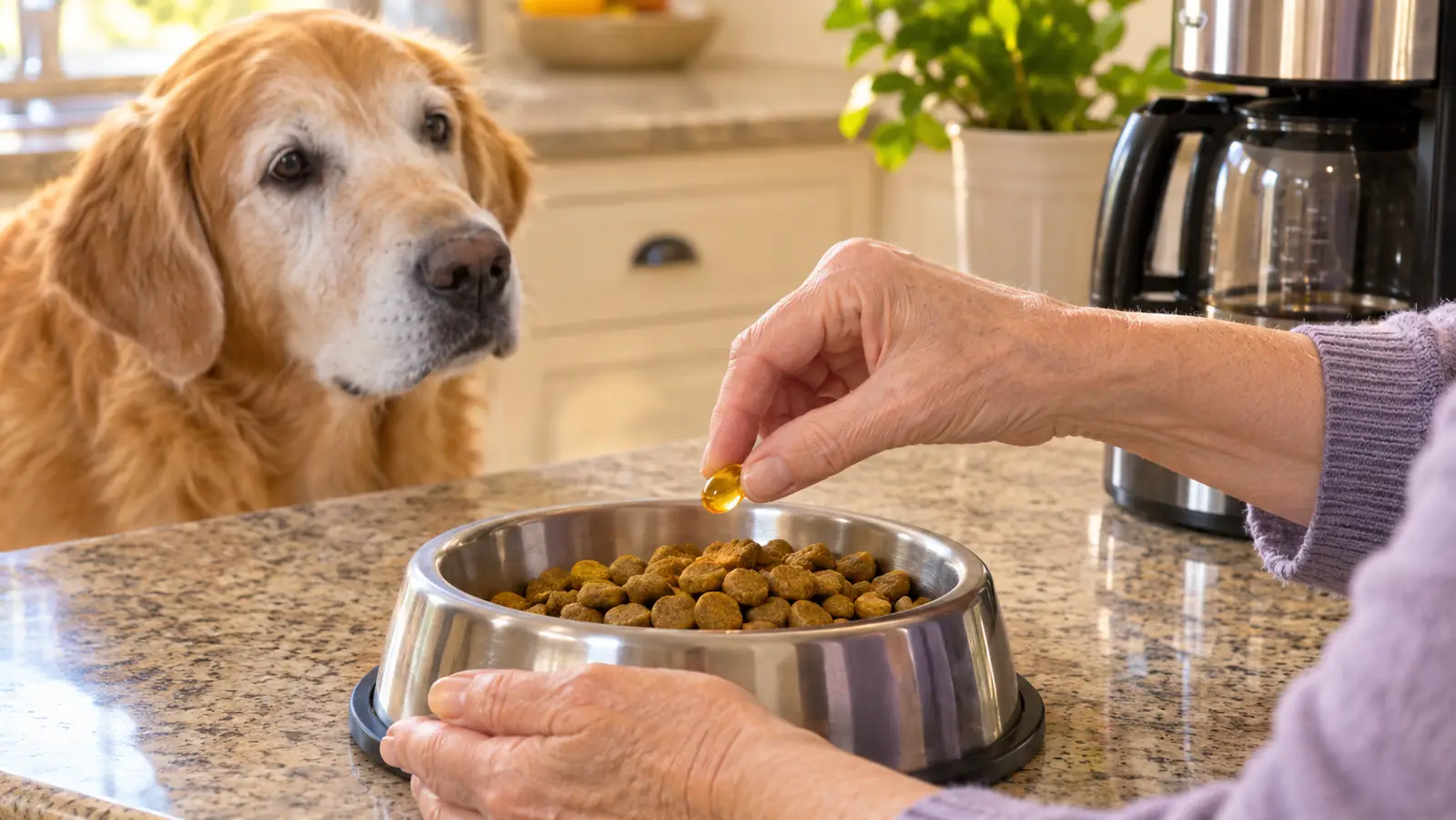
Unflavored fish oil soft gels, 120 to a bottle, fished out one at a time and pushed into kibble. That is the whole routine. No pump, no measuring, no oil on the counter.
Amazon Check Today's Price on Amazon →Step 1: Get Your Vet's Sign-Off Before You Open the Bottle
This is the step people skip, and it is the one that matters most when your dog is already on something else. Murphy was eight weeks into a daily joint chew when I asked about fish oil. Dr. Sandoval wanted to know what he was already taking, what he weighed that month, and whether anything had changed in his stool or his appetite. Then she said yes to adding it, and she said it in a way that made clear the yes was for him, at his weight, alongside the other things he was on.
I asked three specific questions, and I would ask them again. First, does anything he already takes overlap with fish oil in a way that matters. Second, is there a reason to check bloodwork first, given his age. Third, what would you want me to call you about rather than wait for the next visit. Write the answers down. I put mine on the back of an envelope and taped it inside the cabinet door, which sounds excessive until the morning you cannot remember whether the vet said to call about loose stool or about itching.
I have added three supplements to his routine since January. Dr. Sandoval okayed all three together, one at a time, before each one went into the bowl. If your dog is on prescription medication, that conversation is not optional. It is the first thing you do, before you spend anything.
Step 2: Choose a Form You Can Actually Deliver Every Day
In February I tried a pump bottle of salmon oil, because the label made it sound simple and because I liked the idea of a liquid. It was not simple. The pump delivered a squirt that was either too little or too much, the oil sat on top of the kibble in a slick, and by the third week the kitchen smelled like a fish market every morning. I quit it. Not because it was doing harm, but because I dreaded it, and a thing you dread is a thing you stop doing.
The Nordic Naturals bottle I have is 120 soft gels, unflavored, and I take one out with dry fingers and push it into the kibble. No measuring, no pump, no oil on the counter. The label lists EPA and DHA, which is what you are actually buying when you buy fish oil, and it lists them plainly rather than burying them inside a blend name.
I read the label on the counter before I opened the bottle, the way I read everything now. Triglyceride form, which the label says is the form naturally found in fish. Non-GMO, gluten and dairy free, no artificial colors, flavors or preservatives. I cannot tell you that any of that makes a measurable difference in an older dog. I can tell you I would rather give him fewer extra ingredients than more, and this label is short.
The one catch is that Murphy will not take a soft gel on its own. He will take it in his breakfast, after I have mixed it in and walked away for a minute so it is not the obvious strange thing in the bowl. Know your dog on this. A dog that takes pills from your hand is easier. A dog that eats around them is not, and you will need to bury it deeper or choose a different form.
Step 3: Anchor It to Something You Already Do Every Morning
The cabinet to the right of my coffee maker holds three things. The joint chews, the fish oil, and the coffee filters. That is not an accident. The order is chews first, then the soft gel into the kibble, then the coffee. Four minutes, start to finish, and the coffee is my reward for finishing.
Habit stacking is a term from the teaching world as much as anywhere else. You attach the new thing to the thing that already happens without fail. Breakfast happens without fail. The coffee happens without fail. The fish oil goes in between them, where it cannot be forgotten, because the coffee has not been made yet.
I have missed twice since March, both on mornings with a 7 a.m. appointment in town. I did not double up the next day to make up for it. One missed morning is one missed morning. Two in a row is a signal that the anchor is wrong and you need to move the bottle somewhere you cannot walk past.

Step 4: Give It Eight Weeks Before You Decide Anything
I started the soft gels in March. In April I could not tell you a thing. His coat looked the same, his walk looked the same, and I was fairly sure I had wasted the money. This is the point where most people quit, and I understand why, because I nearly did.
By May his coat was noticeably softer, especially over his shoulders and down his back. That is the one change I can point to and say it happened after the fish oil went in. His joints are a different story. I saw no change in how he got up off the bedroom carpet, no change at the back steps, nothing I could honestly credit to the soft gels. I have been giving them for eight months now and that has not changed.
Here is the part that keeps me honest. He is also on a daily joint chew, and he has been on a green lipped mussel chew since May. Three things overlap. I cannot prove which one did what, and anyone who tells you they can, from one dog in one house, is guessing. What I can tell you is that the Nordic Naturals soft gels are the simplest of the three to keep giving, and his coat is better. That is the whole claim.
I also stopped switching products. For the first two months I kept reading about other oils and other forms and wondering whether I had picked wrong. That is not a plan, that is shopping. I decided the soft gels would get eight months before I judged them, and I have stuck to that.
The other thing I did, which felt silly, was take a short video of him getting up off the carpet on the first of every month. Ten seconds, same spot, same time of day. When you live with a dog you cannot see the slow change, because you are inside it. The videos are the only reason I can say with any confidence that the coat changed and the joints did not.
Step 5: Know What Would Make You Stop and Call
Fish oil is fat, and fat does not agree with every dog. If Murphy had gone loose in the stool for more than a day, or started vomiting, or refused his breakfast two mornings running, I would have stopped and called. That is the rule I gave myself before I started, written down while I was still clear headed about it.
The subtler things matter too. Some dogs itch more on fish oil. Some get a fishy smell on the breath that bothers the people in the house more than the dog. Some will eat around the soft gel for a week and then start refusing the bowl entirely. If the supplement is turning mealtimes into a negotiation, it has stopped being worth it.
I keep the bottle in the cabinet with the coffee, and I check the date on the bottom when I open a new one. What the label calls for at his weight is what he gets, and I do not go above that on a stiff morning. More is not better here. If a stiff morning is worse than usual, that is a call to Dr. Sandoval, not a second soft gel.
What Else Helps
Omega-3 is one piece, and on its own it is a small piece. The thing that changed his mornings most was traction. My kitchen and hall are tile, and he was slipping every time he turned around at the water bowl. In February I put down a set of rubber toe grips, and the slipping stopped inside the first week. The socks twist sometimes and I straighten them, but they still grip.
The second piece was lifting. There are two concrete steps at the back door and a running board on the RAV4, and both were becoming a negotiation. In April I started using a soft sling that goes under his hips, with handles I hold. It supports his rear end only. It is not a full body harness and it never goes across his chest. It hangs on a hook by the back door and goes in its bag on vet days. Before it I used a bath towel under his belly, which slid and hurt my shoulders.
The third piece is the boring one, which is weight. He was 74 pounds in January and he is 71 now, and Dr. Sandoval was clear that every pound off his hips is worth more than any bottle on my shelf. That came from measuring his kibble with an actual measuring cup instead of eyeballing it, and from cutting the afternoon biscuits in half. The walks at the park are 20 minutes now instead of 40, and I let him set the pace.
One more thing, and then I will stop. Put the vet visit on the calendar before you need it. Murphy goes back in July and again in January, and I bring the list of what he is on and the videos on my phone. It takes ten minutes, and it means the plan gets adjusted by someone who can actually examine him instead of by me guessing in my kitchen.
None of this treats, cures or reverses arthritis. Not the fish oil, not the chews, not the socks, not the sling. What it does is make a stiff dog's day a little easier while his vet manages the actual disease. That is a smaller promise than most of the labels make, and it is the one I can stand behind.
Eight months in, I can point to a softer coat. I cannot point to a joint change, and I will not pretend otherwise.
One bottle, one soft gel, one anchor in your morning
If your dog already has a breakfast routine, this is the easiest thing you will add to it. Ask your vet first, give it eight weeks, and write down what you actually see.
Amazon Check Today's Price on Amazon →