

Murphy came home in the spring of 2016 and spent his first four years treating the two concrete steps at my back door like a runway. He is ten now, seventy-one pounds, and in January his vet found arthritis in both hips. That is the short version of why a retired PE and health teacher in Redlands, California, has spent ten months reading supplement labels at my kitchen table. This is my honest account of one of them: Zesty Paws Mussel Mobility Bites, the chicken and mussel soft chews he has had most afternoons since May.
Let me be plain about the framing before you read further, because most supplement pages bury this part. I cannot tell you these chews helped my dog. I can tell you what is in them, how I used them, what I watched for over six months, and what I would say to a friend standing in my kitchen. If you came here for a page promising that a ten-year-old retriever will jog again, this is not that page. If you want the label read out loud by someone who taught health for thirty-one years and reads fine print for fun, keep going.
The Quick Verdict
A readable green lipped mussel chew in a format an older dog actually eats. Not a treatment, not a drug, and not something I can credit for one measurable change in six months.
Amazon Check Today's Price →The chew my dog waits by the pantry for
Ninety chicken and mussel soft chews with green lipped mussel, natural glucosamine and chondroitin, and omega-3. The only thing in his cabinet he asks for out loud.
Amazon Check Today's Price on Amazon →How I've Used It
The tub lives on the pantry shelf, not in the kitchen cabinet with the other two supplements, because that is the shelf Murphy can hear from the hall. He gets his chews around noon, after the twenty-minute park walk and after he has had his rest on the cool kitchen tile. The label gives a chew count by weight, and at seventy-one pounds I follow it exactly as printed. Dr. Sandoval had already approved his other two supplements before I added this one, and I asked her about adding a third before I opened the tub.
There was a reason I put this one after the walk instead of with breakfast. Cosequin, a joint chew he has taken since January, goes down with his morning meal. Nordic Naturals fish oil soft gels, a March addition, get tucked into that same breakfast because he will not take one on its own. The afternoon slot was empty, and green lipped mussel was the one thing on my list that made sense as its own occasion rather than a third item piled onto a bowl.
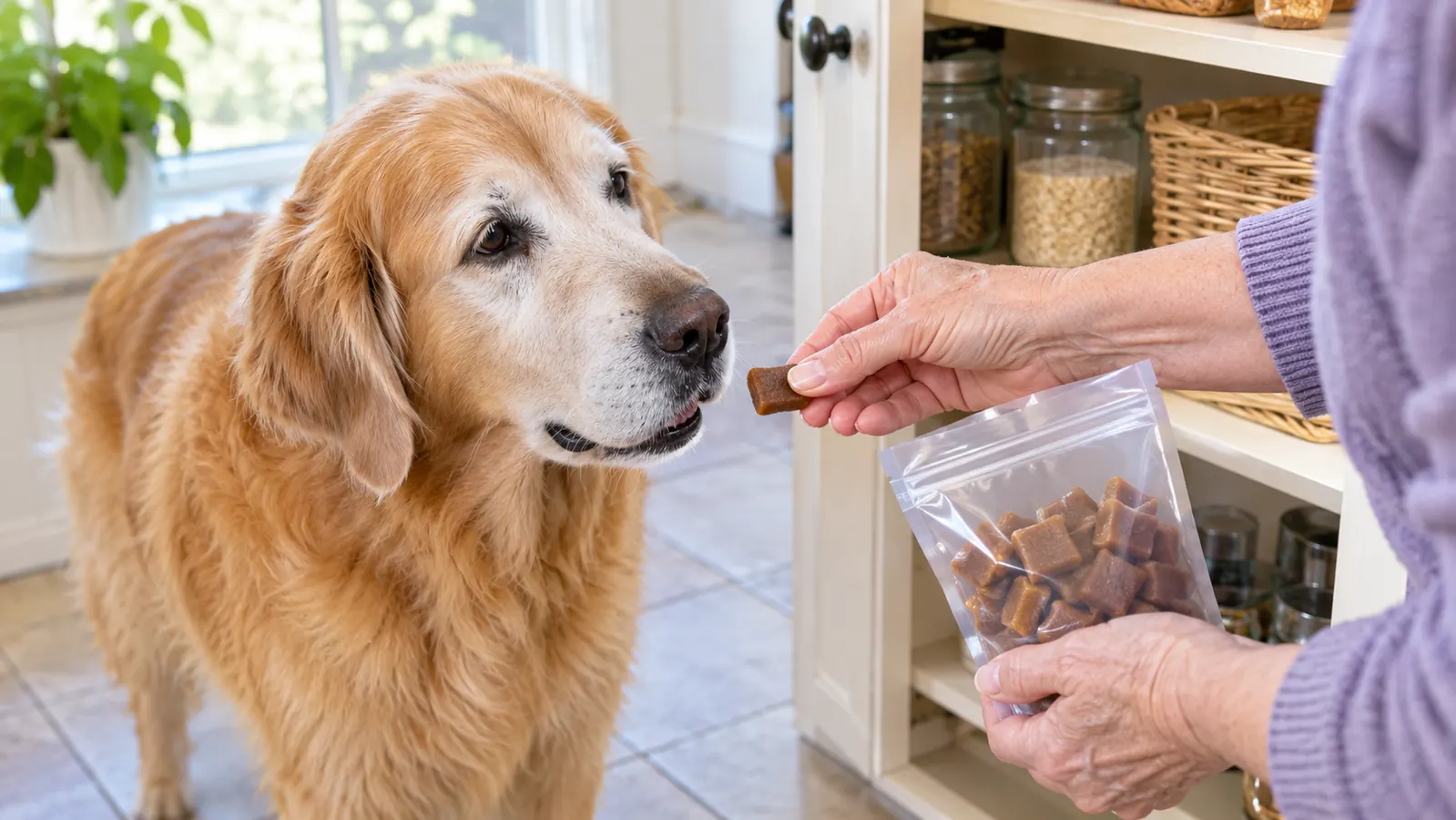
He waits by the pantry now. That is the honest endorsement I can offer: a ten-year-old dog with arthritis in both hips will stand at a shelf and stare at me. He does not do that for the fish oil. He does not do that for the Cosequin, which he takes from my hand because he is polite and because it is breakfast. He does it for a chicken-flavored chew, and I have stopped pretending the enthusiasm is about his hips.
Two practical notes from six months of doing this daily. The first is that a soft chew is the right format for him. He is not a dog who will swallow a tablet inside a piece of cheese anymore; he chews, decides, and either eats it or spits it onto the tile. He has never spat one of these out. The second is that keeping it in the same slot at the same time matters more than people think, because a dog who expects a thing at noon will remind you at noon, and a supplement you forget is a supplement that does nothing.
Storage is unglamorous, but I will mention it because I have thrown things out before. The tub goes back on the pantry shelf with the lid pressed shut, away from the stove and out of the sun, and it has stayed soft through six months of that routine. I have had soft chews go hard in this kitchen when I left them in a cabinet over the kettle. These have not.
What Is Actually In the Tub
Here is what the Zesty Paws listing and the label say, and I am going to stay inside those lines because that is the only part any of us can check. It is a soft chew, chicken and mussel flavor, 90 count, in a 7.9-ounce package. The mussels are green lipped mussels sourced from New Zealand and described as cold processed. The formula also carries natural glucosamine and chondroitin, omega-3 fatty acids, and chamomile, which appears among the listed active ingredients.
Why mussel at all when I already had a glucosamine chew going? Because it is a different ingredient doing a related job. Glucosamine and chondroitin are the pair you see on every joint product on the shelf, and Cosequin had that covered. Green lipped mussel brings its own omega-3 content and its own profile, and I liked the idea of a second source rather than a second scoop of the same thing. Whether that reasoning holds up inside a dog's body is a question for a veterinarian. I am telling you why I chose it, not what it does.
The chamomile deserves a sentence of its own. I taught health, not nutrition, and I read labels like a layman with a highlighter and too much time. Chamomile in a dog chew is usually about calm rather than about joints. That does not make it a bad addition. It does mean this is a blend rather than a single-ingredient product, and a blend is harder to reason about when you are trying to work out what is helping and what is simply present.
I will also say what the front of the tub does not spell out, because it took me a while to notice. The name leads with mussel, and mussel is genuinely the point, but the joint support in the formula is also coming from the glucosamine and chondroitin. If your dog is already on a glucosamine chew, you are not adding a completely separate mechanism. You are adding mussel and omega-3 to a base you already have. That is a fine thing to do. It is simply not the same as adding something entirely new.
What Six Months Actually Looked Like
I keep a small notebook. Not because I am scientific, but because I taught for thirty-one years and I do not trust my memory of a slow change. Here is what is in it since May. First two weeks: nothing. First two months: nothing I could point to. He still took the two concrete steps at the back door one at a time, still paused at the top of them, still let me lift his rear with the sling on cold mornings.
By month four I could write down that his afternoon rest was shorter. He got up off the kitchen tile on his own more often than he had in the spring, and he started meeting me in the hall instead of waiting to be called. Is any of that the mussel chew? It could be the Cosequin, which had eight months of head start. It could be the fish oil, four months in. It could be the traction socks he wears from breakfast to bedtime on the tile, which ended his slipping in the first week and changed how he moves through the house. I have three supplements and two pieces of equipment running at once, and I will not insult you by picking a winner.
The morning walk is my other measure, and it is a crude one. It is still twenty minutes at the neighborhood park, and it was twenty minutes in May as well. What changed is the last stretch home. In the spring he would lag on the sidewalk and I would shorten the loop. Now he finishes it and turns up the driveway without being coaxed. I do not know what to attribute that to, and I am not going to pretend the timing lines up neatly with any one purchase.
What I can report just as honestly is what did not happen. He did not get a bounce. He did not start taking those back steps two at a time. He still hesitates at the top of them when the morning is cold, and the sling still hangs on the hook by that door and still gets used most weeks. If you are hoping a chew will make the diagnosis go away, no product on that shelf will, and to its credit this one does not claim to.
Six months is also long enough to answer the question I actually had, which was whether I would keep buying it. I reordered it. That is the most honest signal I have, and it is a signal about my judgment rather than about his hips. I keep buying it because the dog likes it, because the label is clean enough that I understand what I am putting in his bowl, and because it is a small addition to a routine that is working well enough that I do not want to pull a thread out of it.
What I Liked
- A soft chew an older, fussier dog takes without a fight
- A genuinely different ingredient alongside the glucosamine chew he already had
- Label names what is in it: green lipped mussel, glucosamine, chondroitin, omega-3, chamomile
- Fits an empty slot in the day instead of stacking onto breakfast
Where It Falls Short
- Six months in, I cannot credit it with one change I could measure
- Blend formula makes it hard to isolate what is doing the work
- A 7.9-ounce tub of 90 chews does not sit in the pantry for a year
- Chicken flavor rules out dogs with a poultry problem
I have three supplements and two pieces of equipment running at once, and I will not insult you by picking a winner.

The Parts Nobody Tells You
The first part is arithmetic. A 7.9-ounce tub holding 90 chews sounds generous until you divide by the label's chew count for a seventy-one-pound dog. I will not quote you a daily number from memory, because the label governs and the count moves with weight. What I will say is that this is not a supply that sits in the pantry for a year, and if you are comparing it against something else, compare chew count to your dog's weight rather than tub size to the shelf.
The second is that green lipped mussel is food, not a painkiller. It is a chew with mussel, glucosamine, chondroitin and omega-3 in it, and things in that category move over months or not at all. If your dog is limping, reluctant to rise, holding a leg up, or has changed how he walks in the last week, that is a vet appointment and not a purchase. Murphy's arthritis was diagnosed in January through an examination I did not perform and could not have. Nothing in this article should delay that for your dog.
The third part is aimed at me. I added this Zesty Paws chew because I wanted a second ingredient, not because I had a plan for how I would know whether it worked. A more disciplined version of me would have added it alone, given it eight weeks, and watched. Instead I layered it onto a dog already taking two other things and wearing traction socks on the tile, and now I have a cabinet of products and a notebook full of maybes. If you are starting fresh, add one thing at a time. It is slower and it is the only way to get an answer.
The fourth is the flavor, and it cuts both ways. Chicken and mussel is exactly why Murphy takes it without a fight, and exactly why it is not the right product for a dog with a poultry problem. I have no reason to think that is a concern for him. I mention it because the flavor is the first thing on the label and the last thing most of us check against our own dog.
And the fifth is about comparison, since I suspect that is why you are here. People ask how these stack against Dasuquin, which is the other name that comes up in every conversation about joint chews. I have never used Dasuquin. I have read its label and I have asked Dr. Sandoval about it, and what I can tell you is that the two do not lead with the same ingredient, and that the right one for your dog is a question for the person who examined your dog. A page written at my kitchen table cannot answer it, and any page that says it can is selling rather than explaining.
One more thing, and it is the boring one that matters most. Every one of these decisions went past Dr. Sandoval first, including this one, and she is the reason I did not simply add a fourth product when I was tempted in July. A retired teacher with a notebook and a browser is not a medical authority, and I have tried to write this the way I would want it written for me: here is what I did, here is what I saw, and here is where my knowledge stops.
Who This Is For
This is for the owner of an older dog who already has a diagnosis, already has a joint supplement going, and wants a second ingredient from a different source rather than a larger dose of the same one. It is for someone who can keep one thing in one slot every day and give it months instead of a week. It suits a dog who has gone off tablets and will still take a soft chew. Zesty Paws was a name I recognized before I bought it, which mattered to me more than I expected at my age, and the ingredient list is short enough to read out loud without stumbling.
Who Should Skip It
Skip it if your dog has not been examined by a vet, because a chew is not a diagnosis. Skip it if you want something that works inside a week, because nothing in this category does. Skip it if chicken is a problem for your dog. Skip it if your vet has asked you to keep the total number of supplements down, since a third product is still a third product no matter how readable the label is. And skip it if you are the sort of shopper who adds three things at once and then wants to know which one to blame, because I have been that shopper and the answer never comes.
If you want the one he actually asks for
Chicken and mussel soft chews with green lipped mussel from New Zealand, natural glucosamine and chondroitin, and omega-3. Ninety to a tub, and a label you can read before you buy.
Amazon Check Today's Price on Amazon →