
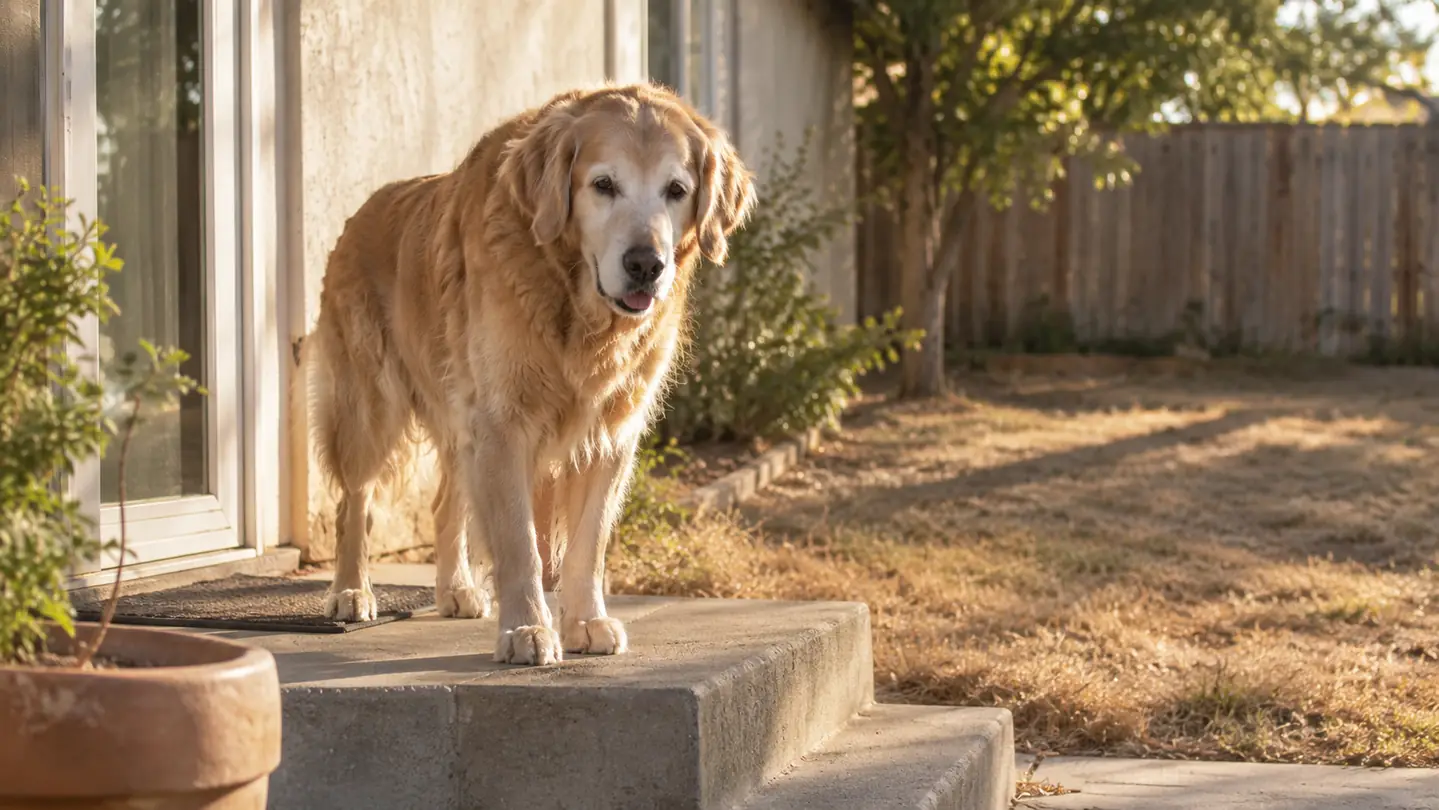
The first time Murphy hesitated at the back steps, I did what most people do. I told myself he was tired. He was ten, a golden retriever mix, seventy-one pounds, and we had just come back from the park. Of course he was tired.
Three weeks later he was still hesitating. Same two concrete steps. Same dog who had bounced down them a thousand times. That is the pattern I want you to watch for, because it is not the same as fatigue. A tired dog lies down. A stiff dog stands there and thinks about it. If that sounds familiar, this guide is the sequence I worked out over ten months with my own dog, in the order I actually did it, plus where a green-lipped mussel chew like Zesty Paws Mussel Mobility Bites eventually landed in the routine.
The afternoon chew I added last, once the floor and the steps were already handled
Zesty Paws Mussel Mobility Bites are chicken-flavored soft chews built around cold-processed New Zealand green-lipped mussel, with natural glucosamine and chondroitin plus omega-3 fatty acids. Ninety to a container, 7.9 ounces, and my dog waits by the pantry for his.
Amazon Check Today's Price on Amazon →Before You Buy Anything, Understand What Is Actually Stiff
I taught health and PE for thirty-one years, so I will explain the joint the way I used to explain a knee to a room of fifteen-year-olds. A joint is two bone ends meeting, with cartilage as the cushion between them and fluid doing the lubricating. Cartilage has no blood supply of its own. It gets what it needs by being loaded and unloaded, which is why movement helps and why a dog who stops moving gets worse.
When the vet told me in January 2026 that Murphy had arthritis in both hips, he was careful with his words. He did not tell me a chew would fix it. He told me what to expect and what to manage. I have kept that framing ever since, and I will keep it here: no product on this page treats, cures or reverses arthritis. What you are doing is managing comfort, keeping muscle on the dog, and removing the small daily obstacles that make a stiff dog move less. That is it. That is the whole job.
Which means the order of operations matters more than the brand on the container. A dog slipping on tile is having a bad time regardless of what is in his bowl. So start with the floor and the steps. Then feed. That is the sequence below, five steps, done in this order over about five months.
Step 1: Get your vet to look at the dog, not at a supplement
Book the exam before you buy a single chew. I know that is not what an article about a mussel chew is supposed to say first, but it is the honest order. Arthritis, hip dysplasia, a soft tissue strain, a cruciate issue and plain old weight gain can all look like the same slow walk from across the kitchen. The treatment differs.
Dr. Sandoval put hands on Murphy's hips, watched him walk away and back, and asked me how long the hesitation had been going on. That conversation is what got us a diagnosis instead of a guess. It also gave me someone to check with before I added each new thing, which I did, one at a time, over the following months. Every supplement in this article was cleared with him first, at what the label says for a dog Murphy's weight.
One more thing from that appointment, because it did more for my dog than any container: the vet weighed him and told me to take four pounds off. I had been adding treats and subtracting walks without noticing. That conversation was uncomfortable and it was correct.
Step 2: Fix the floor and the two back steps before you fix the diet
Our house is tile in the kitchen and hall, carpet in the bedroom. In February 2026 I bought a set of DOK TigerToes traction socks, size Large, four to a set, kept in a basket by the hall. He wore them from breakfast to bedtime, off at night and off for walks, washed weekly.
The change was not gradual. He stopped slipping on the tile inside the first week. Before the socks I had tried rubber toe grips in January and two of them popped off in the first week, which is why I moved to a full sock. The socks do twist sometimes. A couple of them rotate on his foot by the end of the day and I straighten them. They still grip. He chewed at them for two days and then never bothered with them again.
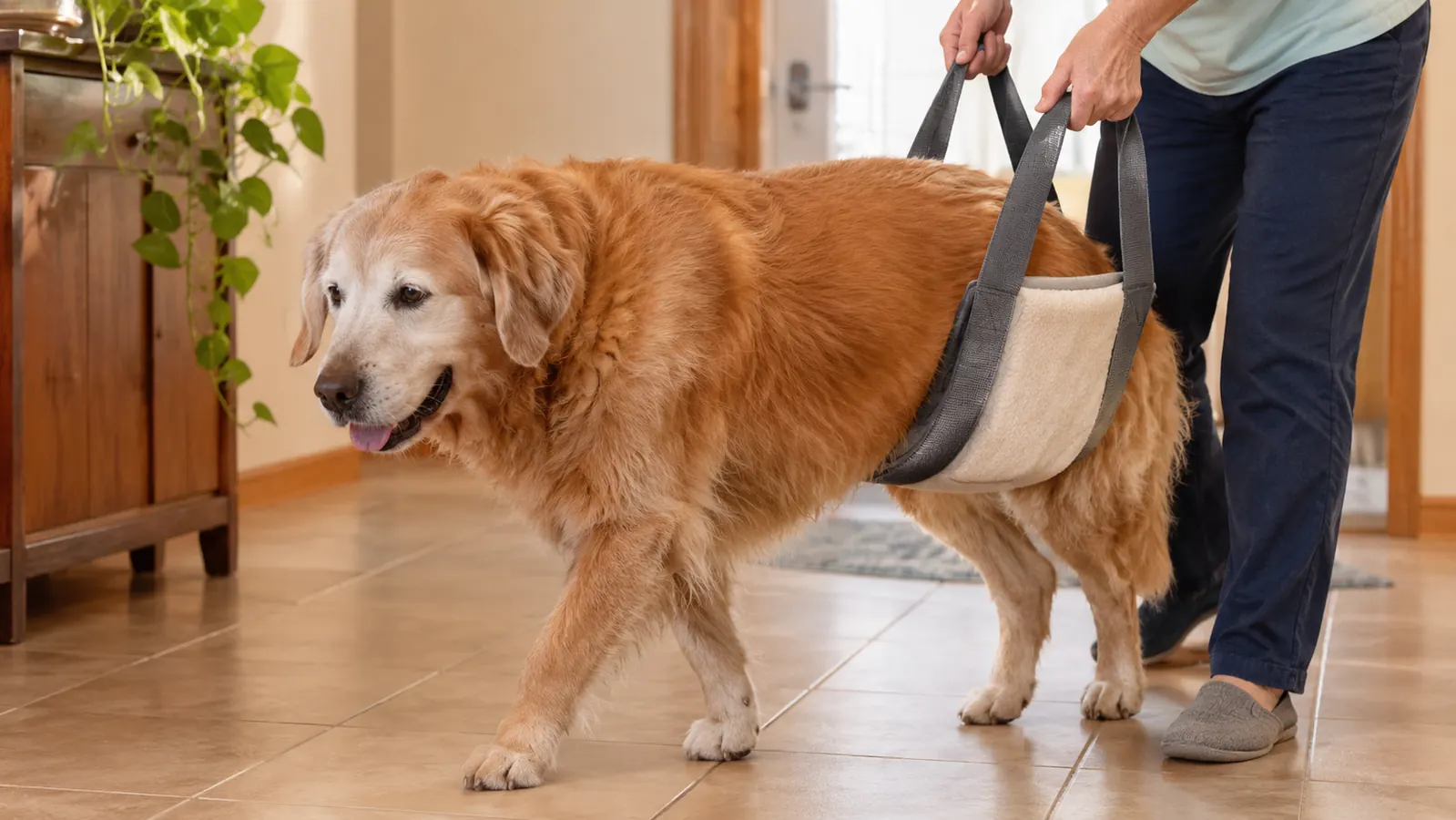
The steps needed a different solution because traction does not help a dog who is being asked to lower his own hindquarters. In April I bought a LOOBANI soft hip sling, size X-Large. It is a padded, fleece-lined panel that goes under his hips with handles I hold. It supports the rear only, it is not a full-body harness, and it never goes near his chest. Amazon calls it a lift harness, so I call it that or just the sling. It hangs on a hook by the back door and travels in its storage bag in the RAV4 on vet days. Before it, I was using a bath towel under his belly and it slid out of my hands on the second step. The sling does not.
Step 3: Add the daily joint chew your vet approves first
Cosequin was the first supplement, bought January 2026, soft chews kept in the kitchen cabinet next to the coffee maker. He takes it from my hand with breakfast. The first month I saw nothing and said so. Around week eight he seemed quicker getting up off his bed in the morning, and I want to be careful about that word seemed, because I was looking for improvement and I was the one who wanted to see it.
Nordic Naturals fish oil soft gels came in March, unflavored, tucked into breakfast because he will not take one on its own. By May his coat looked softer. I saw no joint change I could point to. Before the soft gels I tried a pump bottle of salmon oil in February and quit it inside two weeks because it was messy and it made the kitchen smell like a fish market.
Here is the part most supplement articles leave out. Because I added these one at a time and kept all three in place, I cannot tell you which one did what. I can tell you the dog moves better than he did in January. I cannot tell you the Cosequin did it, or the fish oil, or the mussel chew, or the four pounds he lost, or the socks. Anyone who tells you they can prove it with one dog is selling something.
Step 4: Add a second joint ingredient in a different form, in the afternoon
This is where Zesty Paws Mussel Mobility Bites came in, in May 2026, six months ago. I added it for one reason: green-lipped mussel is a different ingredient from what was already in the Cosequin. I had read enough labels to notice the daily chew and the mussel chew were not simply the same formula in two packages, and I wanted the mussel in the rotation rather than a second version of what he was already getting.
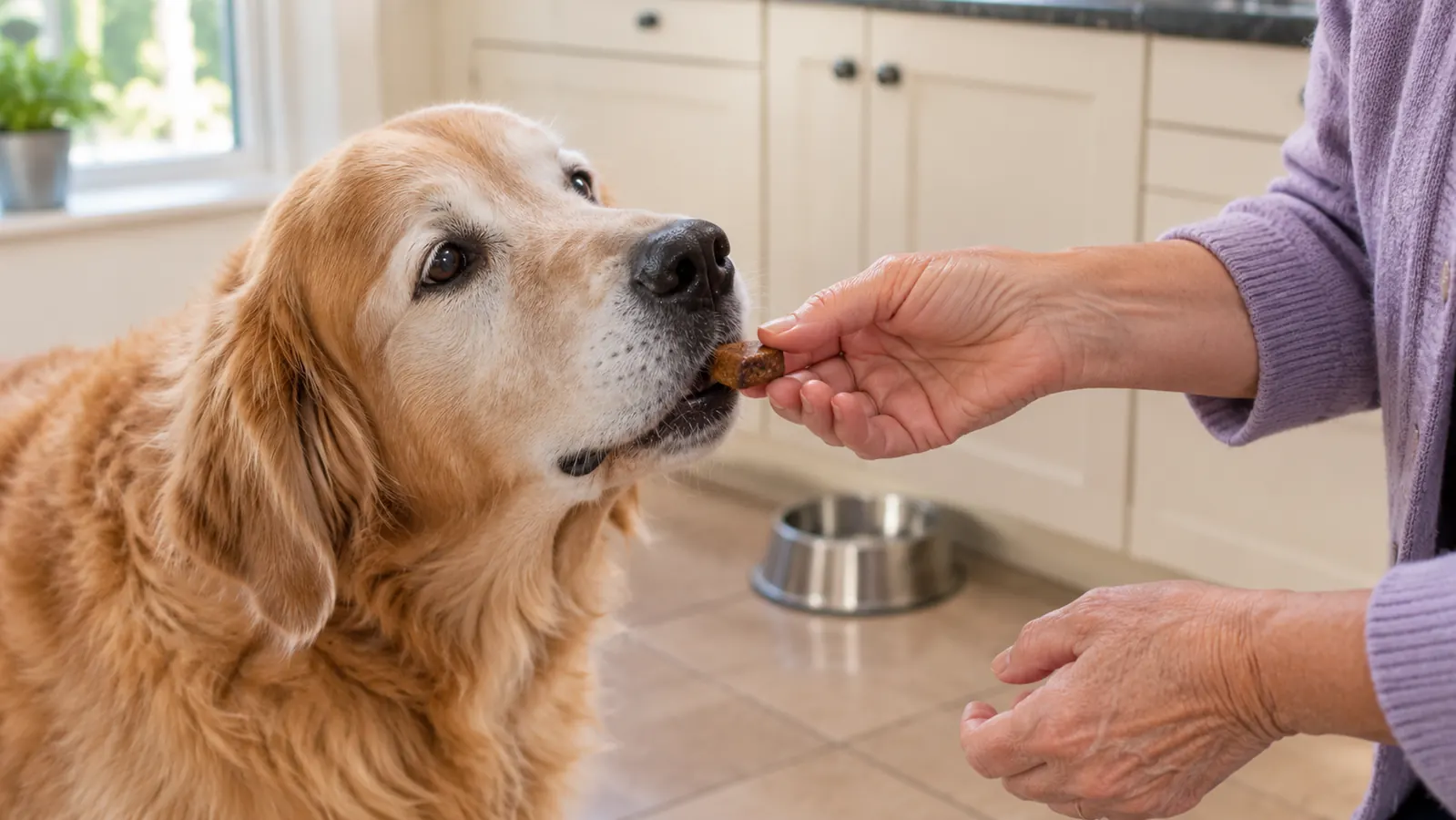
The container lives on the pantry shelf. He gets one around noon, after the morning walk and after he has rested, which is the point of the timing. The walk is when he is stiffest and the rest is when he loosens up, so the afternoon is when he is most willing to take something and when I am least likely to forget. He waits by the pantry. That is not a health outcome, but it does tell me the chew itself is not a fight, and a supplement you have to wrestle a dog to give is a supplement that stops getting given.
The label lists cold-processed New Zealand green-lipped mussel, natural glucosamine and chondroitin, and omega-3 fatty acids, with chicken and mussel flavor in a soft chew. Product benefits on the listing include joint health, muscle health, antioxidant and nutritional support, for hip and joint support in dogs. Container is 90 chews at 7.9 ounces, package dimensions 3.66 by 3.58 by 3.23 inches, so it fits on a pantry shelf without reorganizing anything.
Six months in, no clear change I can credit to the mussel bite alone. I said that about the fish oil and I will say it here. What I can tell you is that his routine now has three different joint ingredients in it, spread across the day, all cleared by the same vet, and he is still walking his twenty minutes at the park, just slower than he used to.
I cannot prove which of the three supplements did what. I can prove the dog stopped slipping on the kitchen tile, and that happened before any of them.
Step 5: Change the walks, not just the bowl
The last step cost nothing. Our morning walk at the neighborhood park used to be longer. Now it is about twenty minutes, and I let him set the pace and stop to sniff. Sniffing is not wasted time for a stiff dog. It is standing still with weight on four legs, which is easier than trotting and still gets him out of the house.
I also stopped letting him jump into the RAV4 on his own. Every time we go anywhere, the sling goes on and I take his hindquarters while he steps up. Vet days, the park when it is too hot to walk there, all of it. The jump down is the part that worried me more than the jump up, and now neither one is his problem.
And I changed the floor in the bedroom, which sounds small. Carpet was already there, so the bedroom was his safe room. When he was sore in the evening he would take himself in there and lie down rather than stay in the kitchen with me. I let him, and I brought my reading into the bedroom instead of calling him back out onto the tile. Ten months in, that is the kind of decision that makes more difference than a switch in brand.
What Else Helps
Two things I would put above any supplement. First, keep the weight down. Every extra pound on a dog with arthritic hips is a pound the joint has to carry on every single step, and unlike a chew, the effect is immediate and measurable. Second, keep muscle on the dog. Short, flat walks on grass and a couple of easy stands-and-sits on carpet do more for a hind end than a longer walk he pays for the next day. I am not a rehab therapist and I do not play one. If your dog is lame or yelping, that is a vet visit, not an adjustment to the routine.
A word on the other products in this category, since you will see them on the same shelf. Dasuquin is one I have never used, so I will not pretend to have an opinion formed by my own dog. My comparison comes from reading labels and from asking Dr. Sandoval questions. If you are choosing between a glucosamine chew and a mussel chew, the honest answer is that they overlap and the decision is smaller than the marketing makes it look. What matters is that you pick one, give it consistently, and give it long enough to know anything. Three weeks tells you nothing.
Also know what these products are not. The socks are traction. The sling is lifting. Neither one does anything for a joint, and neither claims to. They just let the dog move enough that the rest of the routine has a chance to matter.
Who This Is For
This sequence is for the owner of an older dog who has started hesitating at stairs or refusing to jump into the car, who has a diagnosis or is about to get one, and who is willing to spend a little money on boring things like floor grip and a lifting sling before spending it on chews. It is also for the person who already has a supplement cabinet and cannot tell whether any of it is working, which is most of us. If you are at that point, add one thing, keep notes, and give it two months.
And if you want the mussel chew specifically, buy it for the ingredient and the routine, not for a promise. Zesty Paws puts green-lipped mussel, glucosamine, chondroitin and omega-3s in a chicken soft chew that a picky dog will take from your hand. That is a fair description of the product and it is the whole of what I can stand behind after six months.
Six months in, he still walks to the pantry at noon
One soft chew a day, chicken and mussel flavor, 90 to a container. I added it after the floor and the steps were already sorted, and I cleared it with my vet first. That is the order I would do it in again.
Amazon See the Mussel Mobility Bites on Amazon →One last piece of teacher advice, because I cannot help myself. Write down what your dog did today. Not how you feel about it, what he did. Did he take the steps without the pause, did he get up on the first try, did he finish the walk. Do that for two months and you will know more about what is working than any review on the internet, including this one. Ask your vet before you add anything, and take the four pounds off if they tell you to.