
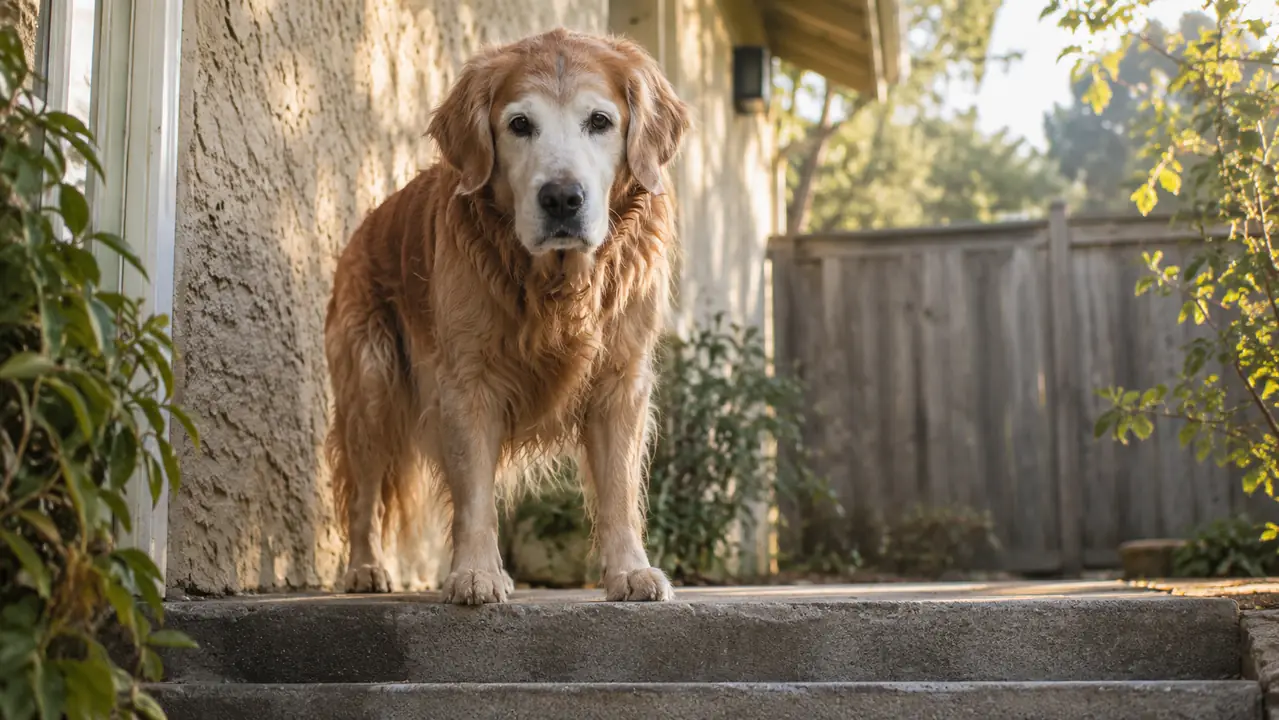
Murphy started hesitating at the two concrete steps off our back door in December. Not refusing them. Hesitating. He would put a front paw down, pull it back, and look up at me as if I had built the steps wrong. He was nine then. By January our vet, Dr. Sandoval, had X-rays and a diagnosis: arthritis in both hips. He is a ten year old golden retriever mix, seventy one pounds, and he came home with me as a puppy in the spring of 2016. The chew he takes every morning now comes from Nutramax Laboratories, sold under the name Cosequin, and it is one part of a routine that took me most of a year to build.
I am not a veterinarian and I am not going to pretend to be one. I taught high school physical education and health for thirty one years, which means I know how a joint is put together and I know that no single purchase rebuilds one. What I can give you is the routine itself: what I read on the label, what I saw in my own dog month by month, what did nothing, and the order I would do it in if I started over tomorrow. Dr. Sandoval made the diagnosis and approved every supplement in this house. Your dog needs his own vet to do the same before you spend money on the wrong thing.
The chew that anchors the whole morning routine
Cosequin soft chews from Nutramax Laboratories: glucosamine hydrochloride, MSM and sodium chondroitin sulfate, 120 soft chews to a tub. Ask your vet about the dose for your dog's weight.
Amazon Check Today's Price on Amazon →Step 1: Get the diagnosis before you buy anything
Arthritis is not something to guess at from the way your dog climbs the porch. Hip arthritis, elbow arthritis, a soft tissue strain, a partially torn cruciate ligament and plain extra weight all look roughly the same from across the kitchen. Dr. Sandoval put her hands on Murphy's hips, watched him walk away from her and back again, and then took X-rays. One appointment, one answer, and it changed what I was shopping for.
The second reason to get a diagnosis is that you need a starting line. You need to know what was wrong and what it looked like on the day you began, or you have nothing to measure eight weeks of chews against. So write the date down and write down what you actually see. Does he hesitate at the steps. Does he need a small push to get up off the carpet. How long does he last at the park before he starts lagging behind you. Memory is a poor record and it gets worse when you are hoping for a result.
While you are in the room, ask one direct question: is there anything about this dog's kidneys, liver or bleeding that would make a glucosamine and chondroitin product a bad idea for him. It is a short question with a short answer and it belongs to your vet, not to me. Murphy's bloodwork came back fine, so we went ahead.
Step 2: Read the label, then match the dose to his weight
The Cosequin soft chews from Nutramax Laboratories list glucosamine hydrochloride, methylsulfonylmethane, which you will see written as MSM, and sodium chondroitin sulfate. Those three are why I picked it over the flavored chews sitting on the same shelf. The label also mentions omega-3 fatty acids, and it ties those to skin and coat rather than to joints, so I do not count them as a joint ingredient in my own head. The tub holds 120 soft chews and measures about 7.5 by 3.38 by 10.25 inches, which is bigger than it sounds, so plan for cabinet space.
That cabinet space matters more than you would think. Mine lives in the kitchen cabinet beside the coffee maker, because the only reliable way I have found to give a dog something every single day is to keep it in the path of a habit I already have. When the tub was in the pantry it was out of sight, and out of sight became three missed days a week before I noticed.
Dosing is not mine to hand out. The label gives directions by weight and that is the number you follow, not a number from a blog, including this one. Murphy is seventy one pounds and he gets what the label says for his weight. I asked Dr. Sandoval to check the label against his chart before I opened the first tub, and I would do that again with any supplement, because labels are written for a range of dogs and dogs are not a range.
One more thing worth saying plainly. The label does not claim this product treats, cures or reverses arthritis, and neither do I. It supports joint health. If you are expecting a diagnosis to disappear, you will be disappointed and the chew will get the blame for it. I went in expecting a dog who moved a little more easily, and that is roughly what I got.
Step 3: Put it in a slot that already exists in your day
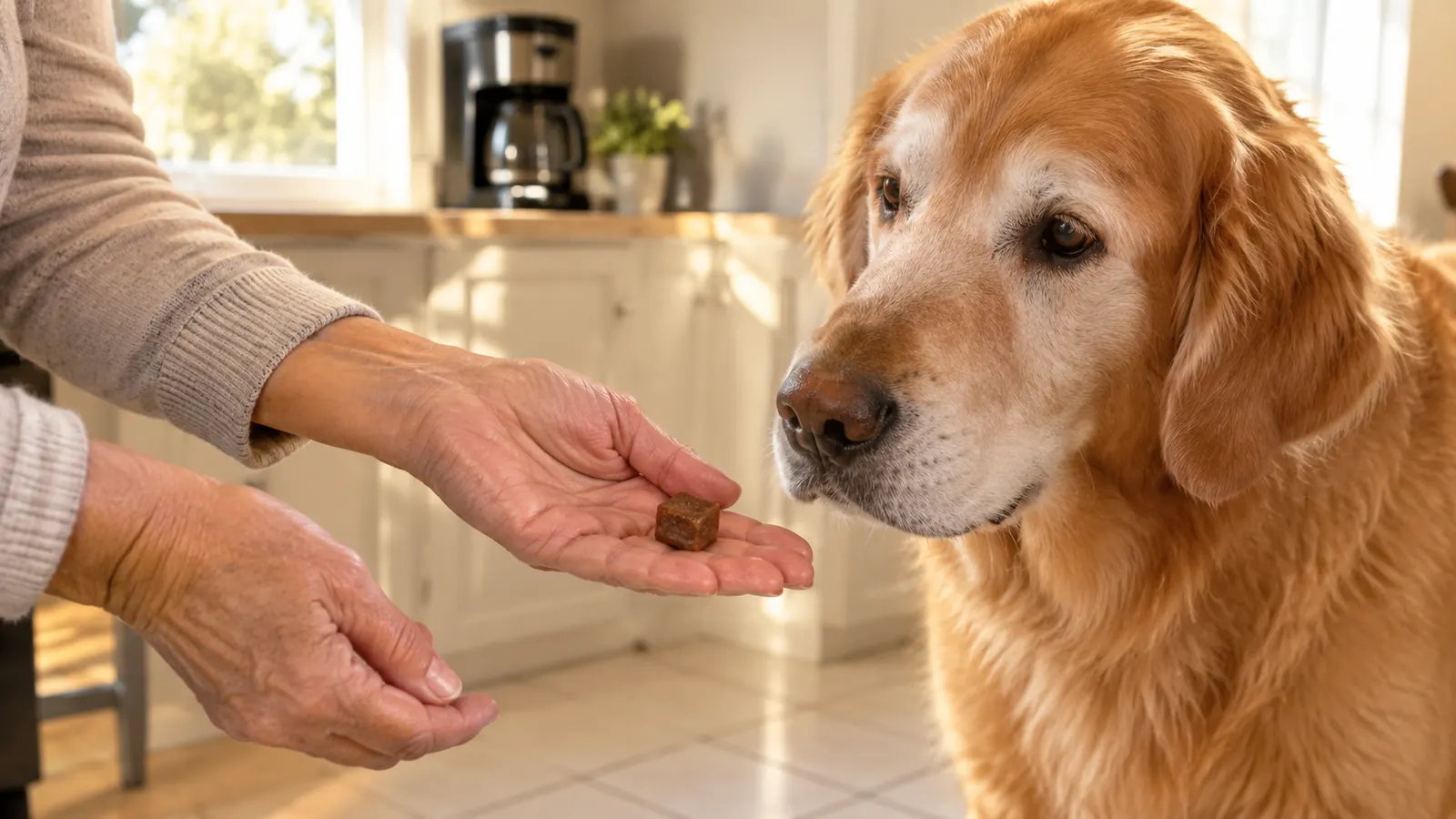
Soft chews fail for boring reasons. The dog eats half and spits the rest on the tile. You forget two days running. Somebody else in the house gives one at noon because they did not know you already had. The fix is a slot in the day that already exists and that only one person owns. Ours is breakfast. The chew goes on top of his kibble or into my hand before I have poured my own coffee, and it is done for the day.
Murphy takes his from my hand now. He was not always easy about it. The first week he sniffed it, looked at me with real suspicion and walked away, so I broke it up into his food. By the second week he was taking it whole. If your dog gulps his food, drop it in the bowl. If your dog picks the good bits out and leaves the rest, hand feeding gets it done faster in my experience.
Missed days matter more than people expect, because the entire point of a daily chew is the daily part. I keep a pencil mark on the calendar by the back door. Not an app, not a reminder on my phone, a pencil. When I look at a month and count twenty eight marks out of thirty one, I know exactly how honest I am being about the routine, and I can stop telling myself a story about it.
Step 4: Fix the floor and the steps, because a chew cannot do that
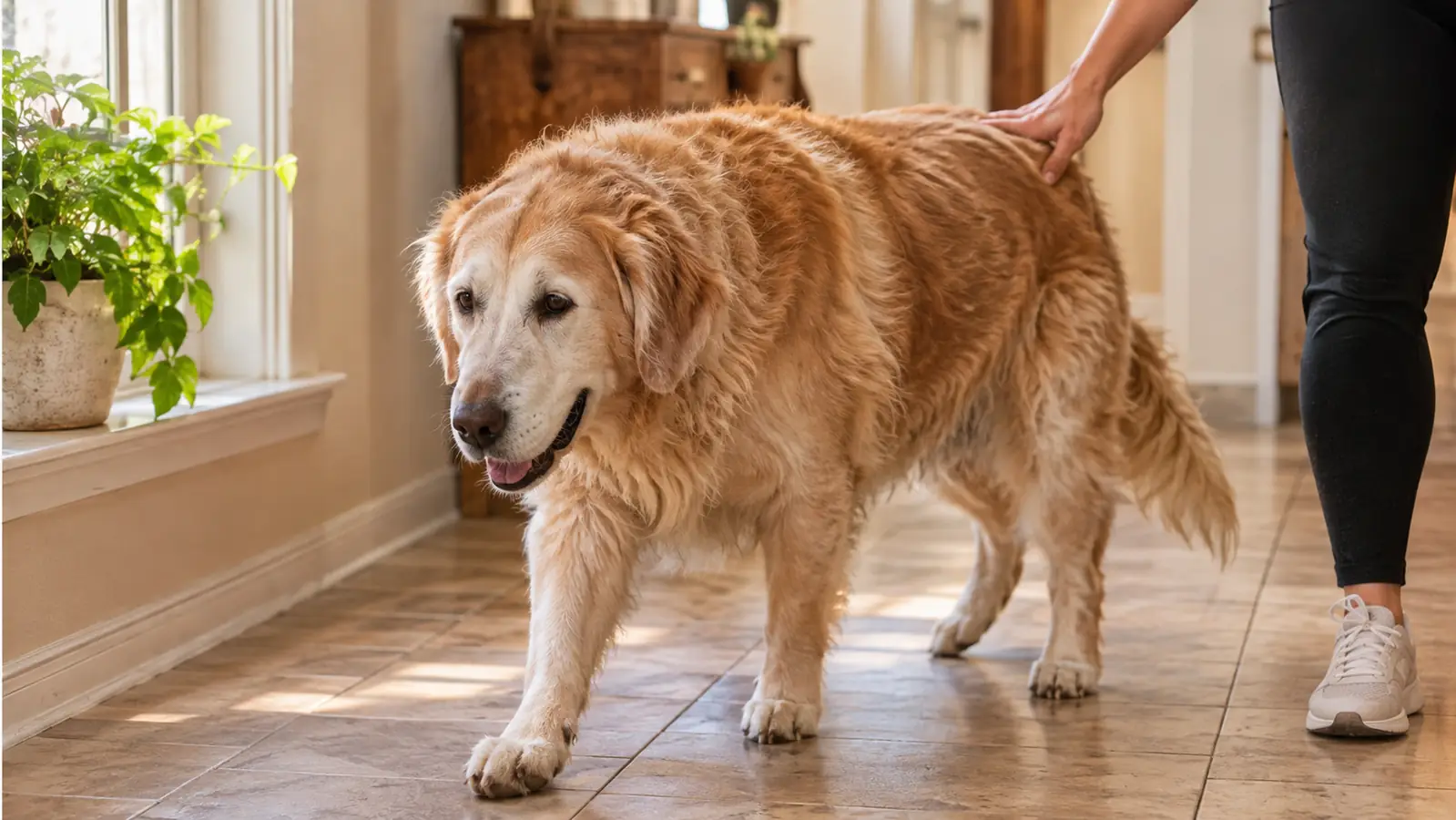
Here is what ten months has taught me. A joint chew works on the dog. It does nothing about the surface he walks on, and tile is where Murphy's back legs used to slide out from under him when he turned too quickly in the hall. In February I put a set of DOK TigerToes grip socks on him, size Large, one set of four. He chewed at them for two days, decided they were furniture and ignored them. They twist sometimes and they still grip. The slipping stopped inside the first week.
The two concrete steps at the back door needed something else. In April I bought a soft sling that goes under his hips, with a padded fleece lined panel and handles I hold. It supports the rear only. It is not a full body harness and it never goes across his chest. Amazon calls it a lift harness and I call it the sling. It hangs on a hook by the back door and it rides in the RAV4 on vet days, because the jump into the back seat was the part he dreaded most. Before it I used a bath towel under his belly, which slid out of my hands at exactly the wrong moment.
I also cut the walk back. Twenty minutes at the neighborhood park became fifteen, and on stiff mornings it is two slow loops around the block instead. That is not a supplement decision, it is a schedule decision, and it probably did more for him than any label claim I could quote you. The same is true of his weight. Every extra pound is weight those hips carry up the steps, and Dr. Sandoval was direct with me about it.
Step 5: Give it eight weeks, and write down what changed
Nothing happened in the first month. I want to be clear about that, because it is easy to find people online who report a different dog in four days. Through January and the first half of February I saw nothing I could point to, and I nearly wrote the whole thing off as an expensive habit. Somewhere around week eight he started getting up off his bed in the morning without the small gathering pause, the one where he rocks forward twice before he commits to standing.
Can I prove the chew did it. No, and I will not pretend otherwise. By then the grips were on his feet and his walks were shorter, so three things changed in the same window, and I would be inventing a story if I told you I could separate them. What I can tell you is the direction things went and roughly when they went, because I wrote it down in one line on the calendar each week.
That is the entire method and it costs nothing. Date, observation, one line. In eight weeks you read your own notes instead of trying to remember a dog from two months ago through a fog of hope. If the notes say nothing changed, you have saved yourself the next tub and a vet visit you can spend on something else. If the notes say he is steadier getting up, you have a reason to keep going and something concrete to bring to Dr. Sandoval.
One last caution and then I will get out of the way. If your dog's mobility drops sharply over a few days, or he stops eating, or he yelps when you lift him, that is not a supplement problem and it is not something to wait out. Call the vet. A chew is a slow, small thing. It does not manage a crisis, and treating it like one costs you time you do not get back.
Somewhere around week eight he started getting up off his bed without the small gathering pause, the one where he rocks forward twice before he commits.
What Else Helps
Two other supplements sit in Murphy's day and I would keep one of them even if I dropped the rest. Unflavored fish oil soft gels came in March, tucked into his breakfast because he will not take one on its own. By May his coat was noticeably softer. I saw no joint change I could point to, and I will not claim one. Before the soft gels I tried a pump bottle of salmon oil in February and quit it inside a week, because it was messy and it left the kitchen smelling like a fish counter.
In May I added a chicken and green lipped mussel soft chew in the afternoon, after his rest from the morning walk. I added it because mussel is a different ingredient from anything in the Cosequin and because Dr. Sandoval said the pairing was fine. He waits by the pantry for it now, which tells you more about his priorities than about his hips. No clear change I can credit to it alone.
Here is the honest problem with three supplements at once. They overlap in time, so I cannot tell you which one did what, and anyone who says they can is either testing one thing at a time with a vet's help or guessing. If you can only afford one thing, buy the joint chew and put your attention there. The other two are additions. They are not replacements for the chew, and none of them replaces the grips, the sling or the shorter walk.
Two last things that cost nothing. Keep his nails short, because long nails change how a dog stands and a dog with sore hips does not need to be standing badly on top of it. And keep him lean. I say that as a retired PE teacher who spent thirty one years telling teenagers the same thing about their own bodies, and as someone who has watched a seventy one pound dog think hard about two concrete steps.
Start with the chew, then build the rest of the routine around it
Cosequin soft chews from Nutramax Laboratories, 120 to a tub, given once each morning with breakfast. Dosing follows the label for your dog's weight, and your vet should confirm it.
Amazon Check Today's Price on Amazon →